All our tours are 100% customizable
Glimpse of Rajasthan – 09 nights/10 days
Price to be reconfirmed - 610 Euro/pp minimum -02 persons

  Delhi--Jodhpur-Ranakpur-Udaipur-Chittorgarh-Pushkar-Jaipur-Abhaneri-Fatehpursikri-Agra-Delhi


Day 1  Arrival in Delhi (Hotel booked from the previous day)

Arrival at New Delhi International Airport.

Once the immigration procedures have been completed and your luggage has been collected, our operator will wait for you outside the Terminal for transfer to the hotel.
Arrival at the hotel and check-in.  Standard check-in at 2:00 p.m. / Check-out at 12:00 p.m.

After breakfast visit

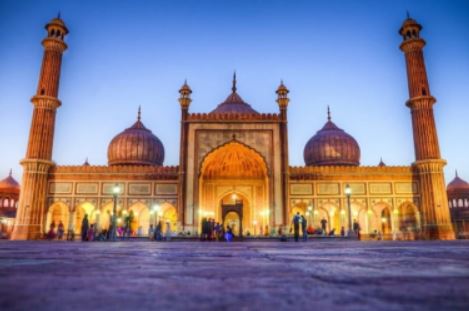
Jama Masjid: - The largest and best-known mosque in India, stands not far from the Red Fort and Chandni Chowk, the oldest and busiest market in old Delhi

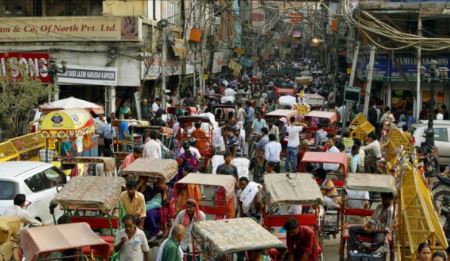
Old Delhi: - The characteristic atmosphere of Delhi's markets can be best enjoyed in Chandni Chowk and generally in the narrow streets teeming with vendors and goods of all kinds at all hours.

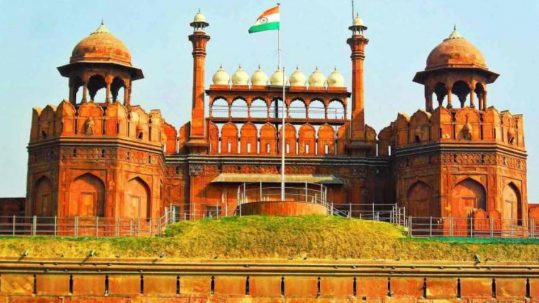
Red Fort (Photo stop): - It is one of the works commissioned by the Mughal emperor Shah Jahan in the 17th century, its construction took approximately 9 years of work and 10 million rupees.

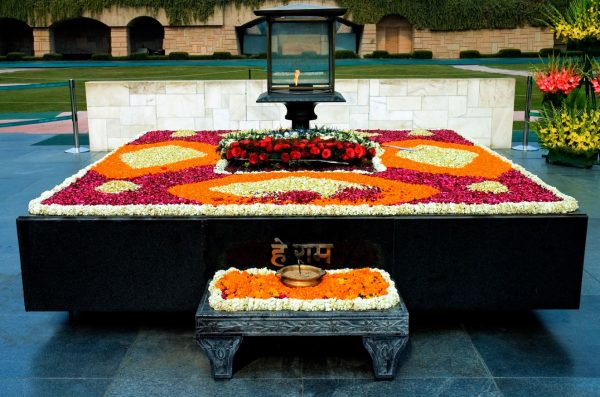
Raj Ghat :- Memorial marking the cremation site of Mahatma Gandhi, a man known as the Father of the Nation and a symbol of world pacifism.

India Gate: -  In the centre of New Delhi stands the 42 m high India Gate, an "Arch of Triumph" like arch in the middle of a crossroads. Almost similar to its French counterpart, it commemorates the 70,000 Indian soldiers who lost their lives fighting for the British Army during the First World War.

Rashtrapati Bhavan and The Parliament Building (Photo stop) - Home to the president of the world's largest democracy, you can also see the old and new parliament house.

Laxmi Narayan Temple: - Lord Narayan is with his consort Goddess Laxmi (the goddess of prosperity), so the temple is called Laxminarayan Temple.

Gurudwara Bangla Sahib: - It is one of the most important Sikh gurdwaras, or house of worship of the Sikhs, linked to the eighth Guru, Guru Har Krishan, it is also known for the swimming pool inside its complex, known by the name of "Sarovar”.

Overnight stay in Delhi.

Day 2 - Delhi-Jodhpur (With flight)

After breakfast, transfer to airport for the flight to Jodhpur

On arrival in Jodhpur visit Mehrangarh Fort, which is the main attraction of Jodhpur. Mehrangarh has unique importance as a repository of artistic and cultural history of the vast areas of central Rajasthan and Marwar.

Jaswant Thada: Beautiful marble monument often described as the 'Taj Mahal of Marwar' was built in memory of Maharaja Jaswant Singhjill of Jodhpur (1873-1895) by his son Maharaja Sardar Singhji (1895-1911) completed in 1906 AD.

Jodhpur Old City and Market - The old city of Jodhpur, founded by Rao Jodhaji DC in 1459, is surrounded by a 10 km wall containing eight gates that serve as entrances.  The new city built around this wall.  Jodhpur is an exquisite combination of modern and traditional buildings.

The Jodhpur local market near the clock tower is famous for its spices, perfumes, handicrafts, footwear, spices and traditional clothing for men and women.

Overnight in Jodhpur.

Day 3 - Jodhpur-Ranakpur-Udaipur (259 km, 5 hours)

After breakfast

Enjoy Bishnoi Village Safari

The Bishnoi village of Jodhpur, Rajasthan is a scenic beauty characterized by Khejri trees and deer.  Also in the village is the Guda Bishnoi lake.  A person interested in wildlife and exotic nature should definitely visit this town.

The Bishnoi and Opium: Although it is now illegal in India and prohibited by the 29 principles of the Bishnoi, the sect still uses it and has received special consent from the Indian government to use opium for "religious" purposes.

Departure for Udaipur 

On the way visit the Ranakpur Jain temple - The temples of Ranakpur are acclaimed throughout the world for their intricate and superb architectural style.  These temples form one of the five major pilgrimages of Jains

Transfer to hotel upon arrival in Udaipur.

Overnight in Udaipur.

Day 4 - Udaipur

After breakfast Visit Udaipur

No city in Rajasthan is as romantic as Udaipur.  This picturesque town sits on the shores of Lake Pichola.  Udaipur is the city of lakes, surrounded by natural and man-made lakes, which are relaxing and crystal clear.
Visit City Palace - It is the largest palace complex in Rajasthan and is located on the eastern bank of the serene Lake Pichola.  Built of marble and granite in 1725 by Maharana Udai Singh.  A fine blend of medieval Indo-European architecture, you will be amazed by the small luxury of its courtyards, stacked walls, terraces, walkways and lush green gardens.

The Jagadish Temple - Next to the City Palace enshrines a black stone image of Lord Vishnu and his vehicle, a powerful bird called Garuda, in a bronze image.  The temple is a good example of Indo-Aryan art.  A majestic garden located on one of the shores of Lake Fateh Sagar,

Saheliyon-ki-Bari – It features expensive lawns, shady sidewalks and impressive fountains.  It is one of the best places in Udaipur to relax.  Later enjoy a boat ride on Lake Pichola (depends on water level).

Lake Pichola -The beautiful expanse of water surrounding the two marvellous structures of Jag Niwas and Jag Mandir, is the lifeline of the city of Udaipur.

Overnight in Udaipur.

Day 5 - Udaipur-Chittorgarh-Pushkar (324 Km, 6 Hours)

After breakfast, drive to Pushkar.

On the way visit the world famous city of Chittorgarh.

Visit Vijay Stambha:- The Jaya Stambha or Victory Tower, located in Chitor Fort, was erected by Rana Kumbha (ruled 1433-1468) in 1448 to commemorate his victory over the Muslim ruler of Delhi.

Chittorgarh Fort: - The Vijaya Stambha (Victory Tower) or Jaya Stambha, called the symbol of Chittorgarh and a particularly bold expression of triumph, was erected by Rana Kumbha between 1458 and 1468 to commemorate his victory over Mahmud Shah El Khaljis, the Sultan of Malwa, in 1440 AD.

Rana Kumbha Palace: - It is one of the major attractions located inside Chittorgarh Fort near Vijaya Stambha.  Originally, the palace was built by Bappa Rawal in 734 AD and later rebuilt by Maharana Kumbha.

Rana Ratan Singh Palace: - Located along Ratneshwar Talab, this palace is one of the best places to visit in Chittorgarh.  Ratan Singh Palace is attributed to Rana Ratan Singh II (1528 – 31 AD).  It has a rectangular plan and is enclosed by a high wall.

Kirti Stambha: - The 22 meter (72 ft) tower was built by a Jain merchant Jeeja Bhagerwala during the reign of Rawal Kumar Singh in c.  1179–1191 AD.

Upon arrival in Pushkar, transfer to the hotel.

Overnight in Pushkar.

Day 6 - Pushkar-Jaipur (148 KM, 2 hours 57 minutes)

After breakfast start the day to visit Pushkar.

Visit Pushkar Lake, Brahma Temple and the local market.

Pushkar is a city overlooking the Thar Desert in the north-eastern Indian state of Rajasthan. It is located on Lake Pushkar, a Hindu sacred site with 52 Ghats (stone stairs) where pilgrims bathe

The Brahma Temple: - The structure dates back to the 14th century. The temple is said to have been built by sage Vishwamitra after the yagna (ritual) of Brahma.  It is also believed that Brahma himself chose the site for his temple.

Pushkar Lake: - It is a sacred lake of Hindus. Hindu scriptures describe him as 'Tirtha-Guru', the perceiver of pilgrimage sites linked to a body of water and link him with the mythology of the creator god Brahma, whose most important temple is located in Pushkar.

Depart to Jaipur.  

Upon arrival visit Galtaji Temple: - The temple is also known as the monkey temple as there are many monkeys in it.  The temple is dedicated to the god Hanumana, built in the 16th century by Diwan Rao Kriparam, who was an advisor to King Sawai Jai Singh II.

Birla mandir:- Birla Temple, Jaipur At the foot of the Moti Dungri fort lies the Birla Temple.  This temple is one of the best attractions in Jaipur.  The Birla Temple in Jaipur is impressive, when illuminated at night.

Overnight in Jaipur.

Day 7 Jaipur

After breakfast the day begins.

Visit Amer Fort, Jantar Mantar, Hawa Mahal, City Palace and Local Market.

Amer Fort: - Amer is a city with an area of ​​4 square kilometres (1.5 sq. mi) located 11 kilometers (6.8 mi) from Jaipur, the capital of Rajasthan.  Located on top of a hill, it is the main tourist attraction in the Jaipur area.

Jal Mahal (Photo Stop): -  Jal Mahal is a work of art which is located in the center of Man Sagar lake, the palace will give you the illusion of almost floating on top of the lake and that is the moment when this The sight takes your breath away.

Jantar Mantar:- It is an equinoctial sundial, consisting of a gigantic triangular gnomon with the hypotenuse parallel to the axis of the earth

Hawa Mahal (Outdoor Photo Stop): - Hawa Mahal (English translation: "Palace of Winds" or "Palace of Breeze") is a palace in Jaipur, India, hence its name because it was essentially a wall of tall screen built in a way that women of the royal family could observe street festivals without being seen from the outside

City Palace, Jaipur, comprising the Chandra Mahal and Mubarak Mahal palaces and other buildings, is a palace complex in Jaipur, the capital of the state of Rajasthan, India.  It was the seat of the Maharaja of Jaipur, the head of the Kachwaha Rajput clan.

Local Market: - Jaipur which is famous for jewellery and clothing is most visited by people who love both.  There are many famous markets in Jaipur selling precious stones, gems, semi-precious stones and jewellery with limited warranty.  buy all this  .

Overnight in Jaipur.

Day 8 Jaipur-Abhaneri-Mehandipur-Bharatpur (202 Km 4 hours and 5 minutes)

After breakfast drive to Bharatpur. En route we visit Abhaneri and  Mehndipur .

Abhaneri is famous for its 'bhaori', wells dug by natives to collect rainwater.  These structures, depending on the time of year, are used as places to cool off or as water tanks.  Chand Baori is the most popular of the wells in the region and is one of the deepest and largest in India

Mehndipur:-  Mehandipur Balaji Temple is a significant site for devotees of Lord Hanuman. This is the only temple in India known to cure people under the influence of black magic or an evil spirit.

Bharatpur National Park: -  Formerly known as Bharatpur Bird Sanctuary, Keoladeo National Park is recognized as one of the world's most important bird nesting and feeding places. It originated as a royal game reserve during the 1850s and was a game reserve for the Maharajas and the British.

Upon arrival, transfer to the hotel.

Overnight stay in Bharatpur.

Day 9 Agra-Delhi (231 km, 3 hours and 55 minutes)

After breakfast.

Visit the Taj Mahal, one of the seven wonders of the world and a must-see for anyone visiting India, it is considered the most romantic work of art in existence.  The construction of this jeweled palace, a symbol of Shah Jahan's undying love for his beautiful wife Mumtaz Mahal, who died after giving birth to her fourteenth child, was completed in 1653 AD

After visiting the Taj Mahal, proceed to visit the Agra Fort.

Agra Fort - The crescent-shaped Agra Fort lies along the banks of the Yamuna River and was commissioned in 1565 by Akbar, one of the greatest Mughal emperors.

Itimad ud daula - Built by Nur Jahan, in memory of his father Ghias-ud-Din Beg, who was given the title 'Itimad-ud-Daulah', meaning 'Pillar of Government'.

Mehtab Bagh - This beautiful garden is located on the western bank of the Yamuna River and is in perfect alignment with the Taj Mahal Gardens located on the other side of the river.

After the visit, departure from Agra to Delhi.

Upon arrival, transfer to the hotel.

Overnight stay  in Gwalior.

Day 10 Delhi – Next Destination

Transfer to New Delhi International Airport as per your flight

Ciao India Tours wishes you a Happy Journey.

Inclusions:

  • 09 nights accommodation in 03 star and heritage hotels with breakfast, including all existing taxes.
  • All transfers from the airport to the hotel and vice versa are scheduled.
  • Meeting and assistance upon arrival by our representative at the airport.
  • All scheduled trips with medium air conditioning car.
  • Flight from Delhi to Jodhpur
  • Wi-Fi in the car.
  • One bottle of water per person every day.
  • All taxes included.
  • The toll, the parking, the fuel, the driver's accommodation.

Exclusions:

  • Visa, International flight, Health insurance, cancellation/change of flights, trains, Alcoholic drinks, Tip, Tourist guide, Tickets for monuments and activities, personal expenses, Camera etc.
  • Everything that is not part of the inclusions.


Contact us to ask for quote via WhatsApp, Chat, query form or email.
WhatsApp - +919971981381
Email – info@ciaoindiatours.com
All our tours are 100% customizable
Tour of Rajasthan with Varanasi – 21 nights/22 days
Price to be reconfirmed - 1246 Euro/pp minimum -02 persons


Delhi-Mandawa-Deshnok-Bikaner-Jaisalmer-Ramdevra-Jodhpur-Ranakpur-Udaipur-Chittorgarh-Pushkar-Jaipur-Abhaneri-Bharaatpur-Fatehpursikri-Mathura-Vrindavan-Agra-Gwalior-Orccha-Khajuraho-Varanasi-Sarnath-Delhi

Day 1  Arrival in Delhi

Arrival at New Delhi International Airport.

Once the immigration procedures have been completed and your luggage has been collected, our operator will wait for you outside the Terminal for transfer to the hotel.
Arrival at the hotel and check-in.  Standard check-in at 2:00 p.m. / Check-out at 12:00 p.m.

After breakfast visit

Jama Masjid: - The largest and best-known mosque in India, stands not far from the Red Fort and Chandni Chowk, the oldest and busiest market in old Delhi

Old Delhi: - The characteristic atmosphere of Delhi's markets can be best enjoyed in Chandni Chowk and generally in the narrow streets teeming with vendors and goods of all kinds at all hours.

Red Fort (Photo stop): - It is one of the works commissioned by the Mughal emperor Shah Jahan in the 17th century, its construction took approximately 9 years of work and 10 million rupees.

Raj Ghat :- Memorial marking the cremation site of Mahatma Gandhi, a man known as the Father of the Nation and a symbol of world pacifism.

India Gate: -  In the centre of New Delhi stands the 42 m high India Gate, an "Arch of Triumph" like arch in the middle of a crossroads. Almost similar to its French counterpart, it commemorates the 70,000 Indian soldiers who lost their lives fighting for the British Army during the First World War.

Rashtrapati Bhavan and The Parliament Building (Photo stop) - Home to the president of the world's largest democracy, you can also see the old and new parliament house.

Laxmi Narayan Temple: - Lord Narayan is with his consort Goddess Laxmi (the goddess of prosperity), so the temple is called Laxminarayan Temple.

Gurudwara Bangla Sahib: - It is one of the most important Sikh gurdwaras, or house of worship of the Sikhs, linked to the eighth Guru, Guru Har Krishan, it is also known for the swimming pool inside its complex, known by the name of "Sarovar”.

Overnight stay in Delhi.

Day 2 - Delhi-Mandawa (243 km, 6 hours)

After breakfast drive to Mandawa.

Visit a small town called Mandawa which is famous for its painted havelis (palaces), it is located in the heart of the Shekhawati region of Rajasthan, known throughout the state for its painted havelis (palaces).  Also called "Rajasthan Open Air Gallery".  Its havelis still show the wealth of the 'Marwari Era' of the 19th century.

Overnight in Mandawa.

Day 3 -Mandawa-Deshnok-Bikaner (192 km, 3:30 hours)

After breakfast, departure to Bikaner.

On the way we visited the Rat Temple (Karni Mata) The temple is famous for the approximately 20,000 black rats that live and are worshiped in the temple.

Arrival in Bikaner, in the afternoon visit to Junagarh Fort and ride in a tuk tuk.

Junagarh Fort – The fort was built under the supervision of Karan Chand, Prime Minister Raja Rai Singh, the sixth ruler of Bikaner, who ruled from 1571 to 1611 AD Construction of the associated walls and moat began in 1589 and was completed in 1594

Tuk Tuk Ride - The Old City area of ​​Bikaner is made up of traditional neighbourhoods, with narrow alleys, historic mansions, residential areas and colourful bazaars.  On this tour, we will explore the vibrant street culture and stately homes (Havelis) of the old town by traveling by auto rickshaw (tuk tuk) and on foot.

Overnight in Bikaner.

Day 4 - Bikaner-Ramdevra-Jaisalmer (250 KM, 5 Hours)

After breakfast, drive to Jaisalmer en route. Visit.

Ramdevra Temple - A small town in Jaisalmer, the most popular destination in Ramdevra is the esteemed Ramdevra Temple.  The temple is the final resting place of Baba Ramdevji, a 14th century saint whom Hindus consider the incarnation of Lord Krishna.

Bhaderiya Temple and Library -This treasure house of knowledge is among the largest libraries in Asia with a collection of around 900,000 books and seating for 4,000 people.  Even those 16 feet underground.  However, the location helps keep it cool even during the scorching summers.

Arrival in Jaisalmer 

Visit Bada Bag - About 6 kilometres north of Jaisalmer is Bada Bagh, also called Barabagh (literally Great Garden).  This garden complex houses royal chhatris or cenotaphs of the maharajas of the state of Jaisalmer, including that of Jai Singh II.  The position of the garden is such that it offers tourists wonderful views of the sunset.

Overnight in Jaisalmer.

Day 5 - Jaisalmer

After breakfast the day begins and we visit

Gadisar Lake - It was built by Maharawal Gadsi in the 14th century and was the main source of drinking water for the city of Jaisalmer.

Sónar Fort - With its golden walls rising from the edge of the desert.  In Jaisalmer you will see beautiful mansions or havelis with balconies and windows covered with fine carved screens.

Heritage Walk - Walk through the old houses and through the local market you can witness the local culture of the place and then visit Patwon Ki Haveli, with its unique architecture and design, it is one of the most important Haveli in Jaisalmer and Rajasthan.

Return to the hotel to rest and then leave for the Thar Desert for the camel ride.

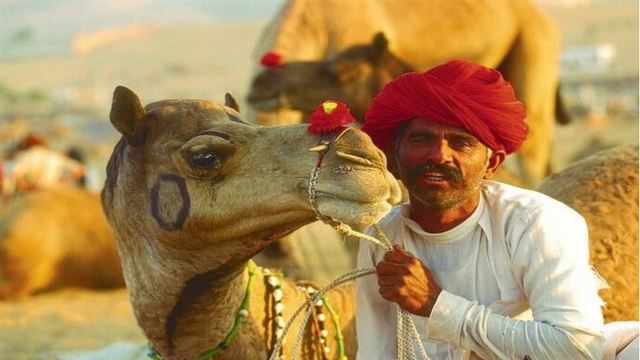
Camel Ride - Thar Desert Camel Ride is the best way to enjoy the beauty of a desert safari in Jaisalmer, the golden city.  From strolling through the sand dunes to enjoying the sight of traditionally decorated camels,

Overnight in Jaisalmer.

Day 6 - Jaisalmer-Jodhpur (286 KM, 5 hours 30 minutes)

After breakfast drive to Jodhpur.

On arrival in Jodhpur visit Mehrangarh Fort, which is the main attraction of Jodhpur. Mehrangarh has unique importance as a repository of artistic and cultural history of the vast areas of central Rajasthan and Marwar.

Jaswant Thada: Beautiful marble monument often described as the 'Taj Mahal of Marwar' was built in memory of Maharaja Jaswant Singhjill of Jodhpur (1873-1895) by his son Maharaja Sardar Singhji (1895-1911) completed in 1906 AD.

Jodhpur Old City and Market - The old city of Jodhpur, founded by Rao Jodhaji DC in 1459, is surrounded by a 10 km wall containing eight gates that serve as entrances.  The new city built around this wall.  Jodhpur is an exquisite combination of modern and traditional buildings.

The Jodhpur local market near the clock tower is famous for its spices, perfumes, handicrafts, footwear, spices and traditional clothing for men and women.

Overnight in Jodhpur.

Day 7 - Jodhpur-Ranakpur-Udaipur (259 km, 5 hours)

After breakfast

Enjoy Bishnoi Village Safari

The Bishnoi village of Jodhpur, Rajasthan is a scenic beauty characterized by Khejri trees and deer.  Also in the village is the Guda Bishnoi lake.  A person interested in wildlife and exotic nature should definitely visit this town.

The Bishnoi and Opium: Although it is now illegal in India and prohibited by the 29 principles of the Bishnoi, the sect still uses it and has received special consent from the Indian government to use opium for "religious" purposes.

Departure for Udaipur 

On the way visit the Ranakpur Jain temple - The temples of Ranakpur are acclaimed throughout the world for their intricate and superb architectural style.  These temples form one of the five major pilgrimages of Jains

Transfer to hotel upon arrival in Udaipur.

Overnight in Udaipur.

Day 8 - Udaipur

After breakfast Visit Udaipur

No city in Rajasthan is as romantic as Udaipur.  This picturesque town sits on the shores of Lake Pichola.  Udaipur is the city of lakes, surrounded by natural and man-made lakes, which are relaxing and crystal clear.
Visit City Palace - It is the largest palace complex in Rajasthan and is located on the eastern bank of the serene Lake Pichola.  Built of marble and granite in 1725 by Maharana Udai Singh.  A fine blend of medieval Indo-European architecture, you will be amazed by the small luxury of its courtyards, stacked walls, terraces, walkways and lush green gardens.

The Jagadish Temple - Next to the City Palace enshrines a black stone image of Lord Vishnu and his vehicle, a powerful bird called Garuda, in a bronze image.  The temple is a good example of Indo-Aryan art.  A majestic garden located on one of the shores of Lake Fateh Sagar,

Saheliyon-ki-Bari – It features expensive lawns, shady sidewalks and impressive fountains.  It is one of the best places in Udaipur to relax.  Later enjoy a boat ride on Lake Pichola (depends on water level).

Lake Pichola -The beautiful expanse of water surrounding the two marvellous structures of Jag Niwas and Jag Mandir, is the lifeline of the city of Udaipur.

Overnight in Udaipur.

Day 9 - Udaipur-Chittorgarh-Pushkar (324 Km, 6 Hours)

After breakfast, drive to Pushkar.

On the way visit the world famous city of Chittorgarh.

Visit Vijay Stambha:- The Jaya Stambha or Victory Tower, located in Chitor Fort, was erected by Rana Kumbha (ruled 1433-1468) in 1448 to commemorate his victory over the Muslim ruler of Delhi.

Chittorgarh Fort: - The Vijaya Stambha (Victory Tower) or Jaya Stambha, called the symbol of Chittorgarh and a particularly bold expression of triumph, was erected by Rana Kumbha between 1458 and 1468 to commemorate his victory over Mahmud Shah El Khaljis, the Sultan of Malwa, in 1440 AD.

Rana Kumbha Palace: - It is one of the major attractions located inside Chittorgarh Fort near Vijaya Stambha.  Originally, the palace was built by Bappa Rawal in 734 AD and later rebuilt by Maharana Kumbha.

Rana Ratan Singh Palace: - Located along Ratneshwar Talab, this palace is one of the best places to visit in Chittorgarh.  Ratan Singh Palace is attributed to Rana Ratan Singh II (1528 – 31 AD).  It has a rectangular plan and is enclosed by a high wall.

Kirti Stambha: - The 22 meter (72 ft) tower was built by a Jain merchant Jeeja Bhagerwala during the reign of Rawal Kumar Singh in c.  1179–1191 AD.

Upon arrival in Pushkar, transfer to the hotel.

Overnight in Pushkar.

Day 10 - Pushkar-Jaipur (148 KM, 2 hours 57 minutes)

After breakfast start the day to visit Pushkar.

Visit Pushkar Lake, Brahma Temple and the local market.

Pushkar is a city overlooking the Thar Desert in the north-eastern Indian state of Rajasthan. It is located on Lake Pushkar, a Hindu sacred site with 52 Ghats (stone stairs) where pilgrims bathe

The Brahma Temple: - The structure dates back to the 14th century. The temple is said to have been built by sage Vishwamitra after the yagna (ritual) of Brahma.  It is also believed that Brahma himself chose the site for his temple.

Pushkar Lake: - It is a sacred lake of Hindus. Hindu scriptures describe him as 'Tirtha-Guru', the perceiver of pilgrimage sites linked to a body of water and link him with the mythology of the creator god Brahma, whose most important temple is located in Pushkar.

Depart to Jaipur.  

Upon arrival visit Galtaji Temple: - The temple is also known as the monkey temple as there are many monkeys in it.  The temple is dedicated to the god Hanumana, built in the 16th century by Diwan Rao Kriparam, who was an advisor to King Sawai Jai Singh II.

Birla mandir:- Birla Temple, Jaipur At the foot of the Moti Dungri fort lies the Birla Temple.  This temple is one of the best attractions in Jaipur.  The Birla Temple in Jaipur is impressive, when illuminated at night.

Overnight in Jaipur.

Day 11 Jaipur

After breakfast the day begins.

Visit Amer Fort, Jantar Mantar, Hawa Mahal, City Palace and Local Market.

Amer Fort: - Amer is a city with an area of ​​4 square kilometres (1.5 sq. mi) located 11 kilometers (6.8 mi) from Jaipur, the capital of Rajasthan.  Located on top of a hill, it is the main tourist attraction in the Jaipur area.

Jal Mahal (Photo Stop): -  Jal Mahal is a work of art which is located in the center of Man Sagar lake, the palace will give you the illusion of almost floating on top of the lake and that is the moment when this The sight takes your breath away.

Jantar Mantar:- It is an equinoctial sundial, consisting of a gigantic triangular gnomon with the hypotenuse parallel to the axis of the earth

Hawa Mahal (Outdoor Photo Stop): - Hawa Mahal (English translation: "Palace of Winds" or "Palace of Breeze") is a palace in Jaipur, India, hence its name because it was essentially a wall of tall screen built in a way that women of the royal family could observe street festivals without being seen from the outside

City Palace, Jaipur, comprising the Chandra Mahal and Mubarak Mahal palaces and other buildings, is a palace complex in Jaipur, the capital of the state of Rajasthan, India.  It was the seat of the Maharaja of Jaipur, the head of the Kachwaha Rajput clan.

Local Market: - Jaipur which is famous for jewellery and clothing is most visited by people who love both.  There are many famous markets in Jaipur selling precious stones, gems, semi-precious stones and jewellery with limited warranty.  buy all this  .

Overnight in Jaipur.

Day 12 Jaipur-Abhaneri-Mehandipur-Bharatpur (202 Km 4 hours and 5 minutes)

After breakfast drive to Bharatpur. En route we visit Abhaneri and  Mehndipur .

Abhaneri is famous for its 'bhaori', wells dug by natives to collect rainwater.  These structures, depending on the time of year, are used as places to cool off or as water tanks.  Chand Baori is the most popular of the wells in the region and is one of the deepest and largest in India

Mehndipur:-  Mehandipur Balaji Temple is a significant site for devotees of Lord Hanuman. This is the only temple in India known to cure people under the influence of black magic or an evil spirit.

Bharatpur National Park: -  Formerly known as Bharatpur Bird Sanctuary, Keoladeo National Park is recognized as one of the world's most important bird nesting and feeding places. It originated as a royal game reserve during the 1850s and was a game reserve for the Maharajas and the British.

Upon arrival, transfer to the hotel.

Overnight stay in Bharatpur.

Day 13 Bharatpur-Fatehpur Sikri-Mathura-Agra (128 Km, 2 hours 50 minutes)

After breakfast, departure for Agra. 

Along the way we visit  Fatehpur Sikri:-  Built by the Mughal emperor Akbar in the mid-16th century, Fatehpur Sikri (i.e. City of Victory) was the capital of his empire for 15 years. Built in Indo-Islamic style, Sikri is a red sandstone complex full of palaces, mosques, temples and other structures.

En route we visit Mathura and Vrindavan. 

Krishna janambhoomi  -  Shri Krishna Janmasthan temple, also known as Shri Krishna Janmabhoomi temple, is centered on the prison cell where Lord Krishna's parents Mata Devaki and Vasudeva were imprisoned by their evil uncle Kansa.

Kans Quila:-  Kans Quila is a fortified castle located in Mathura, India. The fort is named after "Kansa", a king who lived around 5500 BC, in the ancient city of Mathura, India. Kansa was the maternal uncle of Krishna.

Kusum Sarovar:-  Kusum Sarovar is a sacred water tank with a historic sand monument in the background. It is located on the sacred hill of Govardhan between Manasi Ganga and Radha Kund in Mathura.

Prem Mandir:-  Prem Mandir also known as Temple of Divine Love, is dedicated to Goddess Radha and Lord Krishna, Lord Rama and Goddess Sita.  It was fashioned and designed by Jagadguru Shri Kripaluji Maharaj in 2001 and is spread over 54 acres.

Iskcon Temple:-  Iskcon Vrindavan Temple Sri Krishna Balrama Temple is recognized as the first temple built by the International Society for Krishna Consciousness (ISKCON).  Built in 1975 by the ISKCON cult, the foundation of the shrine was laid by Swami Prabhupada (founder of ISKCON) himself.

Overnight stay in Agra.

Day 14 Agra-Morena-Gwalior (120 km, 2 Hours 30 Minutes)

After breakfast,

Visit the Taj Mahal, one of the seven wonders of the world and a must-see for anyone visiting India, it is considered the most romantic work of art in existence.  The construction of this jeweled palace, a symbol of Shah Jahan's undying love for his beautiful wife Mumtaz Mahal, who died after giving birth to her fourteenth child, was completed in 1653 AD

After visiting the Taj Mahal, proceed to visit the Agra Fort.

Agra Fort - The crescent-shaped Agra Fort lies along the banks of the Yamuna River and was commissioned in 1565 by Akbar, one of the greatest Mughal emperors.

Depart to Gwalior, Along the way we visit the temples of Morena.

Bateshwar T emple: - The Bateshwar temple complex is located in Morena district of Madhya Pradesh. Also known as Batesara or Batesvar, the temple complex is located on a hill range about 30 km from Gwalior city, near Padavali village.

The Chausath Yogini Temple:-  The Chausath Yogini  Moraine Temple, also known as the Ekattarso Mahadeva Temple, standing atop a secluded hill about a hundred feet high, this circular temple offers a splendid view of the cultivated fields below.

Upon arrival in Gwalior transfer to hotel.

Overnight stay  in Gwalior.

Day 15 Gwalior-Orccha (120 km, 2 hours 15 minutes)

After breakfast,

Visit Gwalior Fort dominates the city and is its most significant monument. It was the scene of epochal events, imprisonment, battles and jauhar. A steep road winds towards the fort, lined with statues of Jain tirthankaras, carved into the rock face

Depart to Orccha

On arrival visit Orchha Market: -  Orchha market exudes excitement. It is colourful, vibrant and fragrant. When you enter from the parking side of Chaturbhuj temple, you are greeted by the best kept secret of Orchha market

Ramraja Temple -  This beautiful Ram temple has an intriguing history behind it. The idols that were supposed to be installed in the magnificent Chaturbhuj temple were kept on the land where this temple now stands.

Evening Aarti :- At sunset on the beautiful Betwa River attend the evening prayers at the Ram Raja Palace temple.

Overnight stay in Orchha.

Day 16 Orchha-Khajuraho (182 km, 3 hours and 10 minutes)

After breakfast the day begins.

Orchha: - The Orchha Fort complex, which houses a large number of ancient monuments consisting of the fort, palaces, temple and other buildings, is located in the city of Orchha in the Indian state of Madhya Pradesh

Jahangir Mahal: -  The establishment of Jahangir Mahal dates back to the 17th century AD when the ruler of the region Vir Singh Deo built the structure as a symbol of the warm welcome of the Mughal emperor Jahangir

Cenotaphs -  Located on the banks of the Betwa River, Chattris is a collection of magnificent royal tombs of the Maharajas, placed on a platform and supported by pillars.

Sunder Mahal is a splendid palace in Orchha which now serves as a major pilgrimage centre for Muslims. This palace belongs to a Hindu king named Prince Dhurbhajan and his Muslim lover

After visiting Orchha depart to Khajuraho.

Upon arrival visit Gole Market: -  It is the largest and most important shopping destination in the city. It houses various shops selling textiles, ethnic wear, brass and silver artefacts, miniature sandstone replicas etc.

Overnight stay in Khajuraho.

Day 17 Khajuraho-Satna (113 Km, 2 Hours) Satna-Varanasi (By night train)

After breakfast.Visit the temples of Khajuraho.

Khajuraho temples are divided into three groups, the Western Group, the Eastern Group and the Southern Group.

The western group of temples is located west of the Bamitha-Rajnagar road, on the banks of the Sib-Sagar. They include six main buildings and are dedicated to the Shaivite and Vaisnavite cults. Chausath Jogini Temple, Kandariya Mahadeva Temple, Devi Jagdamba Temple, Chitragupta or Bharatji Temple, Vishwanath Temple, Laxmana Temple

Eastern Group of Temples - The Eastern Group of Temples is located in the immediate vicinity of Khajuraho village. The complex comprises three Brahmanical (or Hindu) temples and three large Jain temples, namely, Ghantai Temple, Adinath Temple and Parsawanatha Temple. The Hindu temples are those of Brahma, Vamana and Javari.

Southern Group of Temples - The southern group consists of two temples, the Duladeo and the Jatkari temple.

After the visit of Khajuraho departure for Satna.

Transfer to the train station as per schedule of the train to Varanasi.

Overnight stay in Varanasi.

Day 18 Varanasi

Arrival in Varanasi and transfer to the hotel

After breakfast time to relax

In the afternoon visit Sarnath and tour the city.

Sarnath :-  Sarnath, one of the holiest Buddhist places in the world, is famous for being the place where Gautama Buddha delivered his first sermon. From then until the 12th century AD - almost 1,700 years - it remained a center of great learning, a place of pilgrimage and a vihara (monastery) for monks and scholars

Archaeological Park: -  The colossal ruins are located in the same complex as Dhamek Stupa. The excavation sites of Sarnath have impressive collections of monasteries, stupas, temples, inscriptions, sculptures and other antiquities ranging from the 3rd century BC to the 12th century AD.

Wat Thai Sarnath Temple: -  Wat Thai Sarnath Temple was built by Thai dignitaries in the year 1933. Adorned with well-kept gardens, the Thai temple is built in the Thai architectural style and is run by Thai Buddhist monks.

Benaras Hindu University:-  Varanasi is also known as the “Centre of Education” for centuries.  Since ancient times, people from all over the world have come here to learn various skills.

Godowlia Market: -  Godowlia has narrow streets lined on both sides with squat buildings and small shops selling everything from ordinary everyday household items to hardware, fine silk and brocade fabrics, shawls, zari work, ready-made garments, shoes, beads and bracelets and other trinkets.

Then in the evening proceed to evening prayer ceremony.

The evening prayer called Ganga Aarti :- It is an organized activity which begins by lighting the multi-tiered ceremonial brass lamps and well-synchronized and rhythmic chanting of holy mantras. While some of the priests blow conch shells to sanctify the atmosphere, other priests start waving incense sticks to worship Mother Ganga.

Overnight stay in Varanasi.

Day 19 Varanasi

Today you need to get up early in the morning to take the boat ride. The best part of enjoying the Ganges River is taking a boat ride on the river. The Ganges River flows through the city and there are numerous ghats connecting the river to the mainland. The day of the people of Varanasi living near the Ganges river begins with the holy dip in the Ganges river with the morning 'Surya Namaskar' - Worship to Sun God. In the morning, the old buildings, ashrams and places along the river look as colorful as a rainbow when the sunlight hits them. People bathing and performing rituals. After the boat ride we take a short heritage walk of the city.

Get down from the boat and visit Old city. 

Manikarnika  Ghat :-  It is one of the most famous, sacred and ancient ghats of Varanasi, Manikarnika is the main burning ghat and one of the most auspicious places where a Hindu can be cremated. The bodies are carried to the ghat by the bamboo stretcher covered by the red cloth which is handled by the doms.

The Kashi Vishwanath Temple (Photo Stop): - The Kashi Vishwanath Temple is one of the most famous temples in Varanasi, also known as the Golden Temple dedicated to Lord Shiva. It was built in the year 1780 by the Maratha monarch, Maharani Ahilyabai Holkar of Indore. This makes Varanasi a tourist spot due to the great religious importance for Hindus.

Walking around the Vishwanath Temple or the Golden Temple area is always a unique experience as it has always been the most important cultural and financial area of ​​Varanasi. A visit to the most beautiful temple artwork in the whole city in Gautameshwar Mahadev, the Golden Temple: the most important Shiva temple in all of India, historical mosques, ancient and hidden alleys, bazaar market in Varanasi, architecture of the ancient building of Varanasi along with the largest crematorium on the planet located at Manikarnika ghat will give you a unique and unforgettable walking experience.

Return to the hotel for breakfast.

The Yoga and Meditation class -  Time for yoga and meditation.

Free time to explore to the Ghats of Varanasi

Overnight stay in Varanasi.

Day 20 Varanasi-Delhi (With flight 1 hour and 25 minutes)

After breakfast departure for Delhi. Transfer to Varanasi airport as per the flight schedule for Delhi.

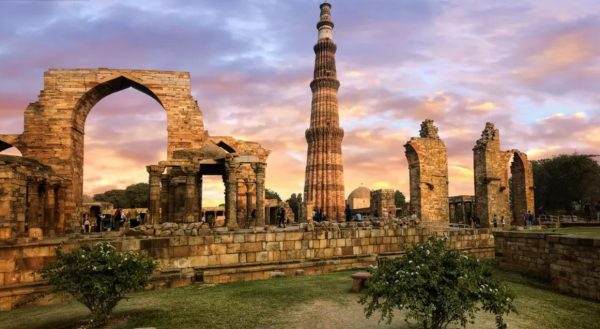
Upon arrival in Delhi we visit the Qutub Minar: -  it is among the most famous monuments, this beautiful 71-meter minaret is considered the tallest tower in the world. The Qutub Minar is one of the many masterpieces that represents the majesty of the Mughal architects.

Connaught place - the large circular market was the largest of its kind in India. The English believed that the horseshoe-shaped market would prove lucky for both shoppers and shopkeepers.

Palika Bazar - This air-conditioned underground market located beneath the inner circle of Connaught Place was established in the late 1970s. It is especially famous for cheap electronic items and clothes. From footwear to clothing to nightwear, from perfumes to accessories to electronic gadgets.

Janpath - Here you can do the best of street shopping. You will find mostly small kiosks selling all kinds of cotton clothes and curios. The clothes are generally export surplus items and are sold cheaply.

Overnight in Delhi. 

Day 21 Delhi

After breakfast the day begins. 

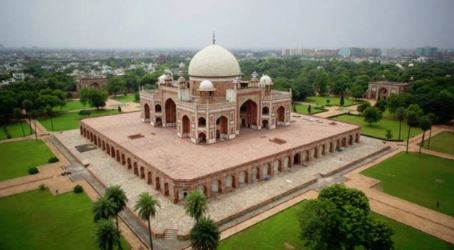
Humayun's Tomb :-  Humayun is the second Mughal Emperor of India who died in 1556, the widow Hamida Banu Begam, also known as Haji Begam, began the construction of his tomb in 1569, fourteen years after her husband's death.

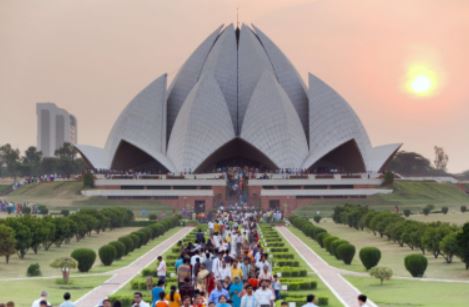
The Lotus Temple: (Closed on Mondays) -  built in 1986 for a total cost of 10 million rupees, it is a Bahai temple also known as the House of Worship and is considered the Mother temple of the Indian subcontinent

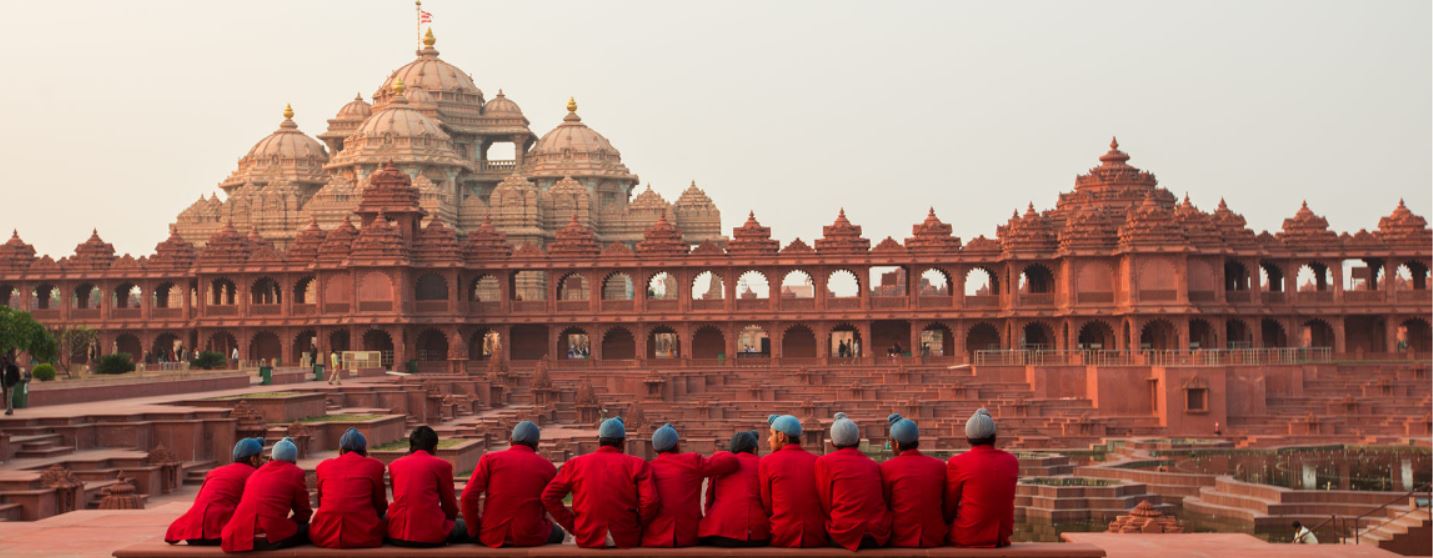
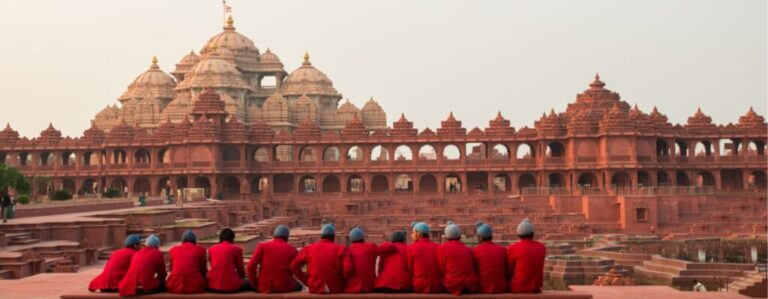
Akhshardham temple (Closed on Mondays)  -  Akshardham' means the divine abode of God. It is hailed as an eternal place of devotion, purity and peace. Swaminarayan Akshardham in New Delhi is a Mandir: an abode of God, a Hindu place of worship, and a spiritual and cultural campus dedicated to devotion, learning, and harmony.

Note: -  Sleeveless dresses, shorts or shorts are not permitted. Electronic products are not permitted.

Overnight in Delhi.

Day 22 Delhi – Next Destination

Transfer to New Delhi International Airport as per your flight

Ciao India Tours wishes you a Happy Journey.

Inclusions:

  • 21 nights’ accommodation in 03 star and heritage hotels with breakfast, including all existing taxes.
  • All transfers from the airport to the hotel and vice versa are scheduled.
  • Meeting and assistance upon arrival by our representative at the airport.
  • All scheduled trips with medium air conditioning car.
  • Wi-Fi in the car.
  • Train from Satna to Varanasi
  • Flight from Varanasi to Delhi
  • One bottle of water per person every day.
  • All taxes included.
  • The toll, the parking, the fuel, the driver's accommodation.

Exclusions:

  • Visa, International flight, Health insurance, cancellation/change of flights, trains, Alcoholic drinks, Tip, Tourist guide, Tickets for monuments and activities, personal expenses, Camera etc.
  • Everything that is not part of the inclusions.


Contact us to ask for quote via WhatsApp, Chat, query form or email.
WhatsApp - +919971981381
Email – info@ciaoindiatours.com
All our tours are 100% customizable
Tour of Rajasthan with Varanasi – 16 nights/17 days
Price to be reconfirmed - 948 Euro/pp minimum -02 persons


Delhi-Mandawa-Deshnok-Bikaner-Jaisalmer-Ramdevra-Jodhpur-Ranakpur-Udaipur-Chittorgarh-Pushkar-Jaipur-Abhaneri-Fatehpursikri-Agra-Varanasi-Sarnath-Delhi

Day 1 Arrival in Delhi 

 Arrival at New Delhi International Airport.

Once the immigration procedures have been completed and your luggage has been collected, our operator will wait for you outside the Terminal for transfer to the hotel.
Arrival at the hotel and check-in.  Standard check-in at 2:00 p.m. / Check-out at 12:00 p.m.

After breakfast visit

Jama Masjid: - The largest and best-known mosque in India, stands not far from the Red Fort and Chandni Chowk, the oldest and busiest market in old Delhi

Old Delhi: - The characteristic atmosphere of Delhi's markets can be best enjoyed in Chandni Chowk and generally in the narrow streets teeming with vendors and goods of all kinds at all hours.

Red Fort (Photo stop): - It is one of the works commissioned by the Mughal emperor Shah Jahan in the 17th century, its construction took approximately 9 years of work and 10 million rupees.

Raj Ghat :- Memorial marking the cremation site of Mahatma Gandhi, a man known as the Father of the Nation and a symbol of world pacifism.

India Gate: -  In the centre of New Delhi stands the 42 m high India Gate, an "Arch of Triumph" like arch in the middle of a crossroads. Almost similar to its French counterpart, it commemorates the 70,000 Indian soldiers who lost their lives fighting for the British Army during the First World War.

Rashtrapati Bhavan and The Parliament Building (Photo stop) - Home to the president of the world's largest democracy, you can also see the old and new parliament house.

Laxmi Narayan Temple: - Lord Narayan is with his consort Goddess Laxmi (the goddess of prosperity), so the temple is called Laxminarayan Temple.

Gurudwara Bangla Sahib: - It is one of the most important Sikh gurdwaras, or house of worship of the Sikhs, linked to the eighth Guru, Guru Har Krishan, it is also known for the swimming pool inside its complex, known by the name of "Sarovar”.

Overnight stay in Delhi.

Day 2 - Delhi-Mandawa (243 km, 6 hours)

After breakfast drive to Mandawa.

Visit a small town called Mandawa which is famous for its painted havelis (palaces), it is located in the heart of the Shekhawati region of Rajasthan, known throughout the state for its painted havelis (palaces).  Also called "Rajasthan Open Air Gallery".  Its havelis still show the wealth of the 'Marwari Era' of the 19th century.

Overnight in Mandawa.

Day 3 -Mandawa-Deshnok-Bikaner (192 km, 3:30 hours)

After breakfast, departure to Bikaner.

On the way we visited the Rat Temple (Karni Mata) The temple is famous for the approximately 20,000 black rats that live and are worshiped in the temple.

Arrival in Bikaner, in the afternoon visit to Junagarh Fort and ride in a tuk tuk.

Junagarh Fort – The fort was built under the supervision of Karan Chand, Prime Minister Raja Rai Singh, the sixth ruler of Bikaner, who ruled from 1571 to 1611 AD Construction of the associated walls and moat began in 1589 and was completed in 1594

Tuk Tuk Ride - The Old City area of ​​Bikaner is made up of traditional neighbourhoods, with narrow alleys, historic mansions, residential areas and colourful bazaars.  On this tour, we will explore the vibrant street culture and stately homes (Havelis) of the old town by traveling by auto rickshaw (tuk tuk) and on foot.

Overnight in Bikaner.

Day 4 - Bikaner-Ramdevra-Jaisalmer (250 KM, 5 Hours)

After breakfast, drive to Jaisalmer en route. Visit.

Ramdevra Temple - A small town in Jaisalmer, the most popular destination in Ramdevra is the esteemed Ramdevra Temple.  The temple is the final resting place of Baba Ramdevji, a 14th century saint whom Hindus consider the incarnation of Lord Krishna.

Bhaderiya Temple and Library -This treasure house of knowledge is among the largest libraries in Asia with a collection of around 900,000 books and seating for 4,000 people.  Even those 16 feet underground.  However, the location helps keep it cool even during the scorching summers.

Arrival in Jaisalmer 

Visit Bada Bag - About 6 kilometres north of Jaisalmer is Bada Bagh, also called Barabagh (literally Great Garden).  This garden complex houses royal chhatris or cenotaphs of the maharajas of the state of Jaisalmer, including that of Jai Singh II.  The position of the garden is such that it offers tourists wonderful views of the sunset.

Overnight in Jaisalmer.

Day 5 - Jaisalmer

After breakfast the day begins and we visit

Gadisar Lake - It was built by Maharawal Gadsi in the 14th century and was the main source of drinking water for the city of Jaisalmer.

Sónar Fort - With its golden walls rising from the edge of the desert.  In Jaisalmer you will see beautiful mansions or havelis with balconies and windows covered with fine carved screens.

Heritage Walk - Walk through the old houses and through the local market you can witness the local culture of the place and then visit Patwon Ki Haveli, with its unique architecture and design, it is one of the most important Haveli in Jaisalmer and Rajasthan.

Return to the hotel to rest and then leave for the Thar Desert for the camel ride.

Camel Ride - Thar Desert Camel Ride is the best way to enjoy the beauty of a desert safari in Jaisalmer, the golden city.  From strolling through the sand dunes to enjoying the sight of traditionally decorated camels,

Overnight in Jaisalmer.

Day 6 - Jaisalmer-Jodhpur (286 KM, 5 hours 30 minutes)

After breakfast drive to Jodhpur.

On arrival in Jodhpur visit Mehrangarh Fort, which is the main attraction of Jodhpur. Mehrangarh has unique importance as a repository of artistic and cultural history of the vast areas of central Rajasthan and Marwar.

Jaswant Thada: Beautiful marble monument often described as the 'Taj Mahal of Marwar' was built in memory of Maharaja Jaswant Singhjill of Jodhpur (1873-1895) by his son Maharaja Sardar Singhji (1895-1911) completed in 1906 AD.

Jodhpur Old City and Market - The old city of Jodhpur, founded by Rao Jodhaji DC in 1459, is surrounded by a 10 km wall containing eight gates that serve as entrances.  The new city built around this wall.  Jodhpur is an exquisite combination of modern and traditional buildings.

The Jodhpur local market near the clock tower is famous for its spices, perfumes, handicrafts, footwear, spices and traditional clothing for men and women.

Overnight in Jodhpur.

Day 7 - Jodhpur-Ranakpur-Udaipur (259 km, 5 hours)

After breakfast

Enjoy Bishnoi Village Safari

The Bishnoi village of Jodhpur, Rajasthan is a scenic beauty characterized by Khejri trees and deer.  Also in the village is the Guda Bishnoi lake.  A person interested in wildlife and exotic nature should definitely visit this town.

The Bishnoi and Opium: Although it is now illegal in India and prohibited by the 29 principles of the Bishnoi, the sect still uses it and has received special consent from the Indian government to use opium for "religious" purposes.

Departure for Udaipur 

On the way visit the Ranakpur Jain temple - The temples of Ranakpur are acclaimed throughout the world for their intricate and superb architectural style.  These temples form one of the five major pilgrimages of Jains

Transfer to hotel upon arrival in Udaipur.

Overnight in Udaipur.

Day 8 - Udaipur

After breakfast Visit Udaipur

No city in Rajasthan is as romantic as Udaipur.  This picturesque town sits on the shores of Lake Pichola.  Udaipur is the city of lakes, surrounded by natural and man-made lakes, which are relaxing and crystal clear.
Visit City Palace - It is the largest palace complex in Rajasthan and is located on the eastern bank of the serene Lake Pichola.  Built of marble and granite in 1725 by Maharana Udai Singh.  A fine blend of medieval Indo-European architecture, you will be amazed by the small luxury of its courtyards, stacked walls, terraces, walkways and lush green gardens.

The Jagadish Temple - Next to the City Palace enshrines a black stone image of Lord Vishnu and his vehicle, a powerful bird called Garuda, in a bronze image.  The temple is a good example of Indo-Aryan art.  A majestic garden located on one of the shores of Lake Fateh Sagar,

Saheliyon-ki-Bari – It features expensive lawns, shady sidewalks and impressive fountains.  It is one of the best places in Udaipur to relax.  Later enjoy a boat ride on Lake Pichola (depends on water level).

Lake Pichola -The beautiful expanse of water surrounding the two marvellous structures of Jag Niwas and Jag Mandir, is the lifeline of the city of Udaipur.

Overnight in Udaipur.

Day 9 - Udaipur-Chittorgarh-Pushkar (324 Km, 6 Hours)

After breakfast, drive to Pushkar.

On the way visit the world famous city of Chittorgarh.

Visit Vijay Stambha:- The Jaya Stambha or Victory Tower, located in Chitor Fort, was erected by Rana Kumbha (ruled 1433-1468) in 1448 to commemorate his victory over the Muslim ruler of Delhi.

Chittorgarh Fort: - The Vijaya Stambha (Victory Tower) or Jaya Stambha, called the symbol of Chittorgarh and a particularly bold expression of triumph, was erected by Rana Kumbha between 1458 and 1468 to commemorate his victory over Mahmud Shah El Khaljis, the Sultan of Malwa, in 1440 AD.

Rana Kumbha Palace: - It is one of the major attractions located inside Chittorgarh Fort near Vijaya Stambha.  Originally, the palace was built by Bappa Rawal in 734 AD and later rebuilt by Maharana Kumbha.

Rana Ratan Singh Palace: - Located along Ratneshwar Talab, this palace is one of the best places to visit in Chittorgarh.  Ratan Singh Palace is attributed to Rana Ratan Singh II (1528 – 31 AD).  It has a rectangular plan and is enclosed by a high wall.

Kirti Stambha: - The 22 meter (72 ft) tower was built by a Jain merchant Jeeja Bhagerwala during the reign of Rawal Kumar Singh in c.  1179–1191 AD.

Upon arrival in Pushkar, transfer to the hotel.

Overnight in Pushkar.

Day 10 - Pushkar-Jaipur (148 KM, 2 hours 57 minutes)

After breakfast start the day to visit Pushkar.

Visit Pushkar Lake, Brahma Temple and the local market.

Pushkar is a city overlooking the Thar Desert in the north-eastern Indian state of Rajasthan. It is located on Lake Pushkar, a Hindu sacred site with 52 Ghats (stone stairs) where pilgrims bathe

The Brahma Temple: - The structure dates back to the 14th century. The temple is said to have been built by sage Vishwamitra after the yagna (ritual) of Brahma.  It is also believed that Brahma himself chose the site for his temple.

Pushkar Lake: - It is a sacred lake of Hindus. Hindu scriptures describe him as 'Tirtha-Guru', the perceiver of pilgrimage sites linked to a body of water and link him with the mythology of the creator god Brahma, whose most important temple is located in Pushkar.

Depart to Jaipur.  

Upon arrival visit Galtaji Temple: - The temple is also known as the monkey temple as there are many monkeys in it.  The temple is dedicated to the god Hanumana, built in the 16th century by Diwan Rao Kriparam, who was an advisor to King Sawai Jai Singh II.

Birla mandir:- Birla Temple, Jaipur At the foot of the Moti Dungri fort lies the Birla Temple.  This temple is one of the best attractions in Jaipur.  The Birla Temple in Jaipur is impressive, when illuminated at night.

Overnight in Jaipur.

Day 11 Jaipur

After breakfast the day begins.

Visit Amer Fort, Jantar Mantar, Hawa Mahal, City Palace and Local Market.

Amer Fort: - Amer is a city with an area of ​​4 square kilometres (1.5 sq. mi) located 11 kilometers (6.8 mi) from Jaipur, the capital of Rajasthan.  Located on top of a hill, it is the main tourist attraction in the Jaipur area.

Jal Mahal (Photo Stop): -  Jal Mahal is a work of art which is located in the center of Man Sagar lake, the palace will give you the illusion of almost floating on top of the lake and that is the moment when this The sight takes your breath away.

Jantar Mantar:- It is an equinoctial sundial, consisting of a gigantic triangular gnomon with the hypotenuse parallel to the axis of the earth

Hawa Mahal (Outdoor Photo Stop): - Hawa Mahal (English translation: "Palace of Winds" or "Palace of Breeze") is a palace in Jaipur, India, hence its name because it was essentially a wall of tall screen built in a way that women of the royal family could observe street festivals without being seen from the outside

City Palace, Jaipur, comprising the Chandra Mahal and Mubarak Mahal palaces and other buildings, is a palace complex in Jaipur, the capital of the state of Rajasthan, India.  It was the seat of the Maharaja of Jaipur, the head of the Kachwaha Rajput clan.

Local Market: - Jaipur which is famous for jewellery and clothing is most visited by people who love both.  There are many famous markets in Jaipur selling precious stones, gems, semi-precious stones and jewellery with limited warranty.  buy all this  .

Overnight in Jaipur.

Day 12 -Jaipur-Abhaneri-Fatehpur Sikri-Agra (241 km 4 hours 30 minutes)

After breakfast drive to Agra.

On the way we will visit the world famous Chand Baori well located in the small village of Abhaneri.

Abhaneri is famous for its 'bhaori', wells dug by natives to collect rainwater.  These structures, depending on the time of year, are used as places to cool off or as water tanks.  Chand Baori is the most popular of the wells in the region and is one of the deepest and largest in India

Fatehpur Sikri -Built by the Mughal emperor Akbar in the mid-16th century, Fatehpur Sikri (or City of Victory) was the capital of his empire for 15 years.  Built in the Indo-Islamic style, Sikri is a red sandstone complex filled with palaces, mosques, temples and other structures.

Overnight in Agra.

Day 13 Agra-Varanasi (By overnight train from Agra or flight from Delhi as you like)

After breakfast.

Visit the Taj Mahal, one of the seven wonders of the world and a must-see for anyone visiting India, it is considered the most romantic work of art in existence.  The construction of this jeweled palace, a symbol of Shah Jahan's undying love for his beautiful wife Mumtaz Mahal, who died after giving birth to her fourteenth child, was completed in 1653 AD

After visiting the Taj Mahal, proceed to visit the Agra Fort.

Agra Fort - The crescent-shaped Agra Fort lies along the banks of the Yamuna River and was commissioned in 1565 by Akbar, one of the greatest Mughal emperors.

Itimad ud daula - Built by Nur Jahan, in memory of his father Ghias-ud-Din Beg, who was given the title 'Itimad-ud-Daulah', meaning 'Pillar of Government'.

Mehtab Bagh - This beautiful garden is located on the western bank of the Yamuna River and is in perfect alignment with the Taj Mahal Gardens located on the other side of the river.

Sadar Bazaar: Located near Agra Cantonment Railway Station, Sadar Bazaar is the most famous place in Agra for products like handicrafts, garments, some delicious sweets, leather products.

Transfer to the train station for overnight train to Varanasi.

Overnight in Delhi.

Day 14 Varanasi

Arrival in Varanasi and transfer to the hotel
After breakfast time to relax
In the afternoon visit Sarnath and tour the city.

Sarnath -  Sarnath, one of the holiest Buddhist places in the world, is famous for being the place where Gautama Buddha delivered his first sermon. From then until the 12th century AD - almost 1,700 years - it remained a center of great learning, a place of pilgrimage and a vihara (monastery) for monks and scholars

Archaeological Park: -  The colossal ruins are located in the same complex as Dhamek Stupa. The excavation sites of Sarnath have impressive collections of monasteries, stupas, temples, inscriptions, sculptures and other antiquities ranging from the 3rd century BC to the 12th century AD.

Wat Thai Sarnath Temple: -  Wat Thai Sarnath Temple was built by Thai dignitaries in the year 1933. Adorned with well-kept gardens, the Thai temple is built in the Thai architectural style and is run by Thai Buddhist monks.

Benaras Hindu University:-  Varanasi is also known as the “Centre of Education” for centuries.  Since ancient times, people from all over the world have come here to learn various skills.

Godowlia Market: -  Godowlia has narrow streets lined on both sides with squat buildings and small shops selling everything from ordinary everyday household items to hardware, fine silk and brocade fabrics, shawls, zari work, ready-made garments, shoes, beads and bracelets and other trinkets.

Then in the evening proceed to evening prayer ceremony.

The evening prayer called Ganga Aarti :- It is an organized activity which begins by lighting the multi-tiered ceremonial brass lamps and well-synchronized and rhythmic chanting of holy mantras. While some of the priests blow conch shells to sanctify the atmosphere, other priests start waving incense sticks to worship Mother Ganga.

Overnight stay in Varanasi.

Day 15 Varanasi

Today you need to get up early in the morning to take the boat ride. The best part of enjoying the Ganges River is taking a boat ride on the river. The Ganges River flows through the city and there are numerous ghats connecting the river to the mainland. The day of the people of Varanasi living near the Ganges river begins with the holy dip in the Ganges river with the morning 'Surya Namaskar' - Worship to Sun God. In the morning, the old buildings, ashrams and places along the river look as colorful as a rainbow when the sunlight hits them. People bathing and performing rituals. After the boat ride we take a short heritage walk of the city.

Get down from the boat and visit Old city. 

Manikarnika  Ghat :-  It is one of the most famous, sacred and ancient ghats of Varanasi, Manikarnika is the main burning ghat and one of the most auspicious places where a Hindu can be cremated. The bodies are carried to the ghat by the bamboo stretcher covered by the red cloth which is handled by the doms.

The Kashi Vishwanath Temple (Photo Stop): - The Kashi Vishwanath Temple is one of the most famous temples in Varanasi, also known as the Golden Temple dedicated to Lord Shiva. It was built in the year 1780 by the Maratha monarch, Maharani Ahilyabai Holkar of Indore. This makes Varanasi a tourist spot due to the great religious importance for Hindus.

Walking around the Vishwanath Temple or the Golden Temple area is always a unique experience as it has always been the most important cultural and financial area of ​​Varanasi. A visit to the most beautiful temple artwork in the whole city in Gautameshwar Mahadev, the Golden Temple: the most important Shiva temple in all of India, historical mosques, ancient and hidden alleys, bazaar market in Varanasi, architecture of the ancient building of Varanasi along with the largest crematorium on the planet located at Manikarnika ghat will give you a unique and unforgettable walking experience.

Return to the hotel for breakfast.

The Yoga and Meditation class -  Time for yoga and meditation.

Free time to explore to the Ghats of Varanasi

Overnight stay in Varanasi.

Day 16 Varanasi-Delhi (With flight 1 hour and 25 minutes)

After breakfast departure for Delhi. Transfer to Varanasi airport as per the flight schedule for Delhi.

Upon arrival in Delhi we visit the Qutub Minar: -  it is among the most famous monuments, this beautiful 71-meter minaret is considered the tallest tower in the world. The Qutub Minar is one of the many masterpieces that represents the majesty of the Mughal architects.

Connaught place - the large circular market was the largest of its kind in India. The English believed that the horseshoe-shaped market would prove lucky for both shoppers and shopkeepers.

Palika Bazar - This air-conditioned underground market located beneath the inner circle of Connaught Place was established in the late 1970s. It is especially famous for cheap electronic items and clothes. From footwear to clothing to nightwear, from perfumes to accessories to electronic gadgets.

Janpath - Here you can do the best of street shopping. You will find mostly small kiosks selling all kinds of cotton clothes and curios. The clothes are generally export surplus items and are sold cheaply.

Overnight in Delhi.  


Day 17 Delhi – Next Destination

Transfer to New Delhi International Airport as per your flight

Ciao India Tours wishes you a Happy Journey.

Inclusions:

  • 16 nights’ accommodation in 03 star and heritage hotels with breakfast, including all existing taxes.
  • All transfers from the airport to the hotel and vice versa are scheduled.
  • Meeting and assistance upon arrival by our representative at the airport.
  • All scheduled trips with medium air conditioning car.
  • Wi-Fi in the car.
  • Train from Agra to Varanasi
  • Flight from Varanasi to Delhi
  • One bottle of water per person every day.
  • All taxes included.
  • The toll, the parking, the fuel, the driver's accommodation.

Exclusions:

  • Visa, International flight, Health insurance, cancellation/change of flights, trains, Alcoholic drinks, Tip, Tourist guide, Tickets for monuments and activities, personal expenses, Camera etc.
  • Everything that is not part of the inclusions.


Contact us to ask for quote via WhatsApp, Chat, query form or email.
WhatsApp - +919971981381
Email – info@ciaoindiatours.com

Tour In North India

Program Preview

Delhi-Haridwar-Rishikesh-Chandigarh-Dharamshala-Amritsar-Srinagar-Phalagam-Gulmarg-Dudapatri-Sonmarh-Kargil-Lamayaruh-Kargil-Khardungla-Nubra-Pangong-Thiksy-Hamis-Tso-Delhi
Tour In North India
Tour In North India

DAY 1, Arrival in Delhi (Hotel booked from the previous day) - Tour In North India

Arrival at New Delhi international airport. Following the habits, the immigration formalities, and the baggage collection, ours will surely come out of the arrival terminal building after which it will be transferred to your hotel.
Capital of India and an important entrance to the country, contemporary Delhi is a vibrant metropolis, which successfully combines in its folds - the ancient with the modern. Among the fast-spiraling skyscrapers, the remains of a time gone by in the form of silent historical reminders of the ancient influence of the region. First impressions for each visitor are a species, city of the garden, lined with numerous beautiful parks.
Upon arrival at the hotel, proceed to check-in at the hotel. Standard Check-in Time at the hotel 1400 hours / Check out 1200 hours. In time proceed to the tour of Old Delhi and New Delhi, the Red Fort (external photo stop), Jama Mosque, Chandni Chowk, and Raj Ghat ..
Brief information on the monuments
In the 17th century, the Mughal emperor, Shah Jahan, made his capital at Shahjahanabad, the area that covers present-day Delhi also called the walled city.
Jama Masjid is the largest and best-known mosque in India. It is flanked by a red fort on one side and the old town Chandni Chowk on the other side. Built by Shah Jahan in the 17th century, Jama Masjid is one of the busiest in Delhi for pilgrims and tourists.
Red Fort (Photo stop) was built by the Mughal emperor Shah Jahan in the seventeenth century, which took about 9 years to complete this magnificent structure and about 10 million rupees to build the fort.
Chandani Chowk The Delhi bazaar novel can best be experienced at Chandni Chowk and around the streets. According to legend, the Chandni Chowk market was established during the reign of the Mughal emperor Shah Jahan.
Raj Ghat, resting place of Mahatma Gandhi. Raj Ghat remembers the man who is known as the Father of the Nation for his tireless and pacifist work to recover the independence of India.
Overnight at hotel in Delhi

DAY 2, Delhi - Rishikesh by Train - Tour In North India

After breakfast, the day starts at 6:00
Departure to Haridwar (by train in the morning)
Early morning train to Haridwar, then departure for Rishikesh by car
we will proceed to check-in at the hotel.
Thanks to the Himalayan foothills, next to the Ganges river, this city is renowned for being a center for the study of yoga and meditation.
Overnight at the hotel in Rishikesh

DAY 3, A Rishikesh - Tour In North India

After breakfast, the day begins at 8:30
Rishikesh is a city in the northern Indian state of Uttarakhand, at the foot of the Himalayas, near the river Ganges. The river is considered sacred and the city is renowned as a center for the study of yoga and meditation. Temples and ashrams (centers for spiritual studies) flank the eastern shore around Swarg Ashram, a traffic-free, alcohol-free and vegetarian enclave upstream of the city of Rishikesh.
Early in the morning, an hour of Yoga with the teacher. Later, after breakfast, we also visit Haridwar, a visit to Temples, Laxman Jhula and Ashrams. In the evening the magical Aarti ceremony on the Ganges. Overnight in the hotel of the Ashram.
Overnight at the hotel in Rishikesh

DAY 4, Da Rishikesh a Chandigarh (By car to the railway station and then by Train)

After breakfast, the day starts at 8:30
Departure to Haridwar by car (Train to Ambala)
Getting to Haridwar and transfer to the train station
Departure for Ambala
Ambala ad and transfer to Chandigarh (by car)
How to get to Chandigarh and transfer to the hotel
Evening at leisure
Overnight in a hotel in Chandigarh

DAY 5, Chandigarh - Tour In North India

After breakfast,
Visit the city of Chandigarh which includes Rock Garden (it is a unique garden composed of various objects of art, but the best part of the rock garden is that each of its works was made using industrial and urban waste), Leisure Valley (the Chandigarh Leisure valley is like a garland of gardens that beautifies the entire city), Sukhna Lake (Sukhna Lake is a beautiful lake located at the foot of the Shivalik chain. this is an artificial lake), the hand-held monument to Chandigarh is one of the most significant monuments of the city and of the Capitol complex (the capitol complex houses the headquarters of the government), initially, it served only as the seat of the Govt of Punjab, but now it has the headquarters of both, the Punjab Govt and Haryana).
Overnight in a hotel in Chandigarh

DAY 6, Chandigarh a Dharamshala By car 

After breakfast, the day starts at 8:30
Departure for Dharamshala
Arrival in Dharamshala and visit of Dharamshala
Dharamshala is a city in the Indian state of Himachal Pradesh. Surrounded by cedar forests on the edge of the Himalayas, this collective city is home to the Dalai Lama and the Tibetan government in exile. The Thekchen Chöling temple complex is a spiritual center for Tibetan Buddhism, while the Library of Tibetan works and archives holds thousands of precious manuscripts. The rest of the day is dedicated to leisure time or for optional activities.
Overnight at the hotel in Dharamshala

DAY 7, Dharamshala 

After breakfast, the day starts at 9:00
We visit Dharamsala surrounded by cedar forests, on the side of the Himalayas, this city is the home of the Dalai Lama and the Tibetan government in exile. Visit McLeod Ganj, St. Johns in the Wood, the English cemetery, the place of the Dalai Lama, and the Norbulingka-Institute.
Overnight at the hotel in Dharamsala

DAY 8, Da Dharamshala ad Amritsar (4 ore 30 minutes (206.8 kilometers)

After breakfast, The day starts at 8:30
Departure for Amritsar
Amritsar advertisement and hotel transfer
In the afternoon Late Touristic visits In the late afternoon, traveled to a Wagah, the border of India-Pakistan, to watch the changing of the guard ceremony. Soldiers from both countries participate in an interesting ceremony and eventually shake hands. The crowds singing patriotic songs on both sides of the border and the disciplined aggression of soldiers made a fascinating scene.
Overnight at the hotel in Amritsar

DAY 9, Amritsar 

After breakfast, the day starts at 9:00

Visit Harminadir sahib temple and Jaliwalabagh bagh.

Overnight in Amritsar

DAY 10, Amritsar - Srinagar( By flight 1 Hr.) 

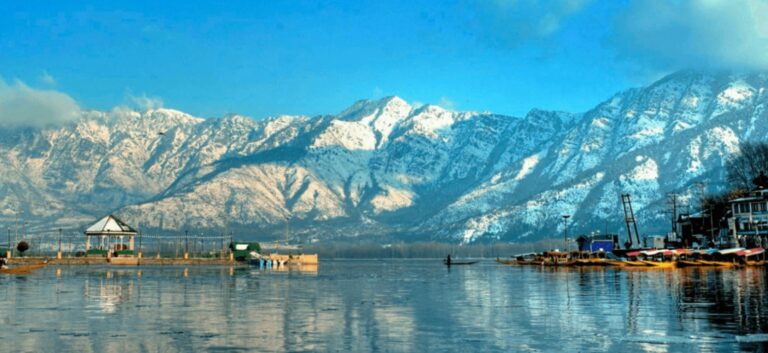
Arrival in Srinagar-Upon your arrival at Srinagar International Airport, you will be met by our representative who will assist you and accompany you to your waiting vehicle. From the airport, it is a 35-minute drive through the heart of the city of New Srinagar. The unit takes you past the Abdullah Bridge that connects the banks of the Jhelum River, taking its path to the northwestern border of Kashmir. We arrive at the houseboat/hotel and check-in. Later it will take a 01-hour shikara tour in the lake since. This boat ride slips you past some wonderful floating vegetable gardens, a center of craftsmanship and lifestyle inherited from people who have lived within the lake for decades.
Overnight on houseboat.

DAY 11, Srinagar-Pahalgam (97 KMS/03 ore)

After breakfast, proceed to Pahalgam, - Tour In North India
You drive to Pahalgam via Pampore where you can visit famous saffron fields, Awantipora and the village of Bijbehara which remains famous as the Kashmir breadbasket. It passes from the national 1A highway to Khanabal and crosses the second largest city of Anantnag. Pahalgam is a picturesque valley around 97 km south of Kashmir. Known as Pahalgam (which means the shepherds' village), the valley is renowned throughout the world for its exotic forests, graceful streams of water, and imposing snow-capped peaks. We arrive in Pahalgam and check in the hotel, after a sightseeing tour around the mountain valley for most of the day,
Overnight at the hotel in Pahalgam

DAY 12, Pahalgam

After breakfast, the day begins
In Pahalgam, you can visit the Aru valley, the Beetab Valley, and Chandanwari (on a direct payment basis) and take a horse ride to the Baisaran meadows. time for leisure
Overnight at Hotel.

DAY 13, Pahalgam-Gulmarg (148 KMS/04 HRS) 

After breakfast proceed to Gulmarg,
Gulmarg (2440 meters above sea level). It is one of the most beautiful hill stations and also called "Meadows of flower". The drive past colorful villages and rice fields gives you a view of Kashmir's rich cultural past. We arrive in a small picturesque market town of Tangmarg and continue on a scenic journey of 14 kilometers from Gulmarg. Gulmarg has one of the best ski slopes in the world and the highest golf course with 18 holes. We arrive in Gulmarg in the early hours of the afternoon and begin a brief tour around the meadow, becoming familiar with the beauty of the place.
Overnight at the hotel in Gulmarg

DAY 14, Gulmarg-Srinagar (56 kms/2 ore 30min).

After breakfast proceed to Srinagar.
We arrive in Srinagar then check in Houseboat / Hotel then proceed for a local sightseeing tour which includes a visit to the famous Mughal Gardens, Cheshma Shahi (royal spring), Nishat (pleasure garden), Shalimar (abode of love) Mughal arranged in the XVI century & These fall along the shore of dal-Lake, in the heart of the city of Srinagar & Shankaracharya Temple situated on a Poggio, thus offering a panoramic view of the whole city, together with famous by-the-lake & river Jhelum, en-route visiting the handloom center famous for pashmina/shahtoosh shawls production & world over carpet mats, the evening will take a 01 HR shikara ride into the lake since. This boat ride slips you past some wonderful floating vegetable gardens, a center of craftsmanship and lifestyle inherited from people who have lived within the lake for decades.
Overnight at Hotel.

DAY 15, Srinagar-Doodhpathri-Srinagar

After breakfast, the day begins 
Today your day will be dedicated to a full-day trip to Doodhpathri. The name Doodhpathri means the valley of milk. The water that is currently flowing through the meadows looks like milk from the distance and remains very cold throughout the year.
Overnight at the hotel in Srinagar

DAY 16, Srinagar-Sonmarg (87 KMS/2hr 30min )

After breakfast
Drive to the majestic mountain resort of Sonamarg. The path to Sonamarg takes us to a picturesque country road where we come across rolling hills, green forests, streams of clear water, and fields of rice in bloom. We will zoom beyond the city of Kangan which handles all the local needs of this region. From Kangan, we will drive to mammar, famous for its trout farm before heading to Sonamarg. We will once again get off our vehicles at the tourist point of Gagangir. The place is built in the middle of the Sindh River and looks like an island with snow-covered glaciers covering one or the other point. In Sonamarg we will take a 3-hour walk or a horse-riding / local Union cabin to the Thajwas glacier (based on direct payment).
Overnight at Hotel

DAY 17, Sonamarg – Kargil

After breakfast
Departure for Kargil (8200 + ft) via Srinagar-Leh Highway. Join Kargil via the Zojilla pass & Drass region. Continue the check-in hotel unit,
Overnight at Hotel.

DAY 18, Kargil – Lamayuru – Leh (224 KMS/07 HRS)

After breakfast
Early morning proceed to Leh (10000 ft -234 KMS-10 hours). Visit Mulbek (known for its huge Buddha statue) and the monastery of Lamayuru (10500 + ft slm - the oldest monastery in Ladakh). Enroute pass the confluence of Indus - Zanskar rivers and the effects of the magnetic hill (the challenge of the law of gravity). Visit Gurudwara Patthar Sahib and the Kali Mata Temple and reach Leh in the evening. Rest for the day check-in the hotel.
Overnight at the Hotel

DAY 19, Leh-Khardungla-Nubra

After breakfast, 
Move to the highest street in the world, Khardungla Pass. Have a cup of tea there, have yourself click the Khardungla sign from BRO & proceed towards Nubra valley covering Deskit Monastery en route. Check-in at the Hotel / Camp, refresh & later you can have a double Hump Bactrian Camel ride. Don't forget to click on this unique mammal, found in the cold desert. It was once used to transport commercial material on the Silk Road.
Overnight in Hotel.

DAY 20, Nubra – Leh

After breakfast, 
Visit Deskit monastery, hot springs, Panamik via a confluence of Shyok & Nubra River through Sumoor. Return to Leh in the evening. 
Overnight in Leh.

DAY 21, Leh-Pangong

After breakfast, the day begins
Located at an altitude of 4300 meters, the crystal-clear brackish waters of Lake Pangong change its color in many shades of blue and green with the position changing the sun in the sky. About 1/4 of the lake is found in India and the rest flows into the Tibet region of China. It is a breeding point for various migratory birds, such as the bar-headed goose and brahmin ducks. Spangmik Village: located about 7 kilometers along the southern shores, it is the farthest village in the Pangong area. From here, you can enjoy a spectacular view of the Chang-Chenmo Range mountains.
Overnight at the hotel

DAY 22, Leh -Tour of the monastery

After breakfast, the day begins
Today you can make an exciting visit to Stok, Shey, Thiksey, and Hemis monasteries. Shey - located on the eastern bank of the Indus River, the small village of Shey is located about 15 km from Leh. The place is popular for the ancient palace and the monastery. The Shey Palace was the residence of the royal family built in the seventeenth century. Also, you can see the ruins of a fortress above the Palace. Shey Monastery also has a three-story image of Buddha Sakyamuni made of gilded copper. Thiksey Monastery - situated atop a hill, the monastery is an excellent example of Ladakhi architecture. This contains several stupas, statues, thangkas, wall paintings, and a large pillar depicting the teachings of the Buddha. Hemis Monastery - built in 1630, this is the largest and most famous monastery in Ladakh. It is located at a distance of 49 km from Leh and 30 km from Thiksey. Stok - it is a small village located at a distance of 14 km from Leh. The Stok Palace and Stok Monastery are the main attractions of this place. The Stok Palace is now the residence of members of the royal family.
Overnight at the hotel

DAY 23, Leh al Lago Tsomoriri-Leh

After breakfast 
Proceed to Tsomoriri Lago (14,000 ft Above sea level) passing Chumathang (Hot Spring) along the Indus river. 1600 hours of Tsomoriri arr. then take a walk around the lake to enjoy the scenic beauty. 
Overnight in Leh

DAY 24, Leh-Delhi ( Via Volo 1 ora 30 minute)

After breakfast
Transfer to the airport according to the flight schedule for New Delhi
Arrival in Delhi and transfer to the hotel
overnight stay in a hotel in Delhi

DAY 25, Delhi-Your Next Destination

Transfer to the airport according to the flight schedule
Ciao India Tours wishes you a very happy journey
Tour In North India
Tour In North India

Golden Triangle In India
Program Preview
Delhi-Jaipur-Agra-Delhi
Golden triangle in India

DAY 1, Arrival In Delhi – Golden Triangle in India

Arrival at New Delhi international airport. Following the habits, the immigration formalities, and the baggage collection, ours will surely come out of the arrival terminal building after which it will be transferred to your hotel.
Capital of India and an important entrance to the country, contemporary Delhi is a vibrant metropolis, which successfully combines in its folds – the ancient with the modern. Among the fast-spiraling skyscrapers, the remains of a time gone by in the form of silent historical reminders of the ancient influence of the region. First impressions for each visitor are a species, city of the garden, lined with numerous beautiful parks.
Upon arrival at the hotel, proceed to check-in at the hotel. Standard Check-in Time at the hotel 1400 hours / Check out 1200 hours. In time proceed to the tour of Old Delhi and New Delhi, the Red Fort (external photo stop), Jama Mosque, Chandni Chowk, and Raj Ghat ..
Brief information on the monuments
In the 17th century, the Mughal emperor, Shah Jahan, made his capital at Shahjahanabad, the area that covers present-day Delhi also called the walled city.
Jama Masjid is the largest and best-known mosque in India. It is flanked by a red fort on one side and the old town Chandni Chowk on the other side. Built by Shah Jahan in the 17th century, Jama Masjid is one of the busiest in Delhi for pilgrims and tourists.
Red Fort (Photo stop) was built by the Mughal emperor Shah Jahan in the seventeenth century, which took about 9 years to complete this magnificent structure and about 10 million rupees to build the fort.
Chandani Chowk The Delhi bazaar novel can best be experienced at Chandni Chowk and around the streets. According to legend, the Chandni Chowk market was established during the reign of the Mughal emperor Shah Jahan.
Raj Ghat, resting place of Mahatma Gandhi. Raj Ghat remembers the man who is known as the Father of the Nation for his tireless and pacifist work to recover the independence of India.
Overnight at hotel in Delhi

DAY 2, Delhi –Golden Triangle in India

After breakfast, the day starts at 8:30
Visit Humayun’s Tomb, Qutub Minar, Lotus temple, Bangla Sahib
Humayun’s era is the second Mughal Emperor of India who died in 1556 and his widow Hamida Banu Begam, who also called Haji Begam, began the construction of his tomb in 1569, fourteen years after his death. Humayun’s tomb is the first example of a true mogul style, inspired by Persian architecture.
Qutab Minar is among the highest and most famous monuments in the world. This beautiful minaret is 234 feet high and is considered to be the tallest tower in the world. The Qutab Minar is one of many masterpieces depicting the sheer brilliance of Mughal architects.
Parliament House and President’s House (Photo stop)The Parliament of India is the supreme legislative body of the Republic of India. It is a bicameral legislature of the President of India and the two houses: the Rajya Sabha and the Lok Sabha The Rashtrapati Bhavan is the official residence of the President of India located at the Western end of Rajpath in New Delhi, India.
The Lotus Temple, The Lotus Temple, located in Delhi, India, is a Bahá’í House of Worship that was dedicated in December 1986. Notable for its flowerlike shape, it has become a prominent attraction in the city. Like all Bahá’í Houses of Worship, the Lotus Temple is open to all, regardless of religion or any other qualification.
Gurudwara Bangla Sahib is one of the most prominent Sikh gurdwara, or Sikh house of worship, in Delhi, India and known for its association with the eighth Sikh Guru, Guru Har Krishan Sarovar
Overnight at hotel in Delhi

DAY 3, Da Delhi A Jaipur (281 KM, 5 Hours) – Golden Triangle in India

After breakfast at the hotel, the day begins
Departure for Jaipur
Arrival in Jaipur and transfer to the hotel. More You visit Birla Mandir. and local market
Birla Temple, Jaipur At the foot of the fort Moti Dungri is the Birla Temple. This temple constitutes one of the most beautiful attractions of Jaipur. The Birla Temple of Jaipur is gorgeous when it is illuminated during the night. The construction of the temple began in 1977 and continued until 1985. On 22 February 1985, the temple deity was invoked and opened to the public to be visited. the temple was built by Birla Group of Industries, one of India’s business magnates. The Temple is dedicated to Sri Visnu (Narayan), the conservator, and his consort Lakshmi, the Goddess of wealth. For this reason, the Birla Temple is also known as Laxmi Narayan Temple. Birla Mandir is built in the best quality of white marble. The three huge temple domes represent three different approaches to religion. The beautiful temple in white marble enchants the onlookers when it shines at night.
Local Market, Free Time to tour the local market famous for local attired, perfumes, jewelry, etc.

DAY 4, A Jaipur – Golden Triangle in India

After breakfast visit of Amer fort.
Amer Fort is a fort located in Amer, Rajasthan, India. Amer is a town with an area of 4 square kilometers located 11 kilometers from Jaipur, the capital of Rajasthan. Located high on a hill, it is the principal tourist attraction in Jaipur.
City Palace, The City Palace, Jaipur was established at the same time as the city of Jaipur, by Maharaja Sawai Jai Singh II, who moved his court to Jaipur from Amber, in 1727. The most prominent and most visited structures in the complex are the Chandra Mahal, Mubarak Mahal, Shri Govind Dev Temple, and the City Palace Museum.
Jantar Mantar – Jantar Mantar is located in the modern city of New Delhi. It consists of 13 architectural astronomy instruments. The site is one of five built by Maharaja Jai Singh II of Jaipur, from 1723 onwards, revising the calendar and astronomical tables
Hawa Mahal (Photo Stop) is a palace in Jaipur, India. Made with the red and pink sandstone, the palace sits on the edge of the City Palace, Jaipur, and extends to the Zenana, or women’s chambers. The structure was built in 1799 by Maharaja Sawai Pratap Singh, the grandson of Maharaja Sawai Jai Singh, who was the founder of Jaipur.
Overnight in a hotel in Jaipur 

DAY 5, From Jaipur To Agra (240 KM 4 Hours 30 Mins) – Golden Triangle in India

After breakfast, the day starts at 8:30
Departure for Agra
You visit Abha Neri step well Abhaneri step well, Fatahpursikri
The era of Abhaneri originally called Abha Nagri, which means “city of brightness”, is a cause of erroneous declaration, the name has been changed. The city is now in ruins but attracts tourists from all over the world.
Abhaneri is prominent for the ‘Baoris’, wells that were invented by the natives to collect rainwater. These tanks are used as cold storage areas and as water reservoirs during the year. Chand Baori is the most popular of the wells in the region and is one of the deepest and largest of India. There are three ways to reach the water. This colossal and delicately carved well is located in front of the temple of Harshat Mata. It was a ritual to wash your hands and feet at the well before visiting the adjacent temple.
Fatehpur Sikri built by the Mughal emperor Akbar in the mid-16th century, Fatehpur Sikri was to be a new capital for his empire. Built in an almost uniform style, Sikri is a complex sprawling of palaces, mosques, temples, and other structures. It is a splendid fusion of the present Persians and Indian construction.
Overnight at the hotel in Agra

DAY 6,  Agra – Golden Triangle in India

After breakfast at the hotel, the day begins
Taj Mahal It is one of the seven wonders of the world and a place to be seen in India. He is the living example of the romantic life of Shah Jahan and his beautiful wife Mumtaz Mahal. The construction of this beautiful monument was completed in 1653 AD. The Mughal king Sha Jahan built this as a final resting place for Queen Mumtaz.
After the visit of the Taj Mahal, we proceed to visit the Agra Fort.
Agra Fort Immersed in the strong banks of the Yamuna river, this crescent-shaped fort was commissioned by Akbar, one of the greatest emperors of the Mughals, in 1565. Surrounded by mighty bastions, the complex has numerous palaces, gardens, and sales inside the fort. and other historic sites.
Overnight at the hotel in Agra

DAY 7,  From Agra To Delhi ( 238 KM 4 Hours)

After breakfast, the day starts at 9:00 AM
Departure for Delhi
Arrival in Delhi and transfer to the hotel
Rest of the day at leisure.
Overnight at hotel in Delhi

DAY 8, Delhi-Italia

Transfer to the airport according to the flight schedule
Ciao India Tours wishes you a very pleasant journey.

« Incredible tour of India »

Program Preview

Delhi-Amritsar-Srinagar-Pahalgam-Gulmarg-Sonmarg-Kolkata-kochi-Munnar-Aleppy-Mumbai-Delhi

DAY 1, Arrival in Delhi (Hotel booked from the previous day) Incredible tour of India

Arrival at New Delhi international airport. Following the habits, the immigration formalities, and the baggage collection, ours will surely come out of the arrival terminal building after which it will be transferred to your hotel.
Capital of India and an important entrance to the country, contemporary Delhi is a vibrant metropolis, which successfully combines in its folds - the ancient with the modern. Among the fast-spiraling skyscrapers, the remains of a time gone by in the form of silent historical reminders of the ancient influence of the region. First impressions for each visitor are a species, city of the garden, lined with numerous beautiful parks.
Upon arrival at the hotel, proceed to check-in at the hotel. Standard Check-in Time at the hotel 1400 hours / Check out 1200 hours. In time proceed to the tour of old Delhi and New Delhi, the Red Fort (external photo stop), Jama Mosque, Chandni Chowk, and Raj Ghat ..
Brief information on the monuments
In the 17th century, the Mughal emperor, Shah Jahan, made his capital at Shahjahanabad, the area that covers present-day Delhi, also called the walled city.
Jama Masjid is the largest and best-known mosque in India. It is flanked by a red fort on one side and the old town Chandni Chowk on the other side. Built by Shah Jahan in the 17th century, Jama Masjid is one of the busiest in Delhi for pilgrims and tourists.
Red Fort (Photo stop) was built by the Mughal emperor Shah Jahan in the seventeenth century, which took about 9 years to complete this magnificent structure and about 10 million rupees to build the fort.
Chandani Chowk The Delhi bazaar novel can best be experienced at Chandni Chowk and around the streets. According to legend, the Chandni Chowk market was established during the reign of the Mughal emperor Shah Jahan.
Raj Ghat, resting place of Mahatma Gandhi. Raj Ghat remembers the man who is known as the Father of the Nation for his tireless and pacifist work to recover the independence of India.
Overnight at hotel in Delhi

DAY 2, Delhi - Amritsar(By Train 7 Hrs.) - Incredible tour of India

After breakfast, The day starts at 8:30 
Departure for Amritsar
Arrive in Amritsar and transfer to the hotel
In the afternoon Late Touristic visits In the late afternoon, traveled to a Wagah, the border of India-Pakistan, to watch the changing of the guard ceremony. Soldiers from both countries participate in an interesting ceremony and eventually shake hands. The crowds singing patriotic songs on both sides of the border and the disciplined aggression of soldiers made a fascinating scene.
Overnight at the hotel in Amritsar

DAY 3, Amritsar - Incredible tour of India

After breakfast, the day starts at 9:00 
Visit to the city of Amritsar. Visit the beautiful Harmandir Sahib, also known as the Golden Temple. It is the spiritual and cultural center of the Sikh religion. The main sanctuary is in marble and is a center of a picturesque body of water. The sacred book of the Sikhs - the Guru Granth Sahib is housed in this holy and peaceful shrine. The roof of the building is gold leaf, giving the temple its name. The community kitchen - the langar - offers free meals to anyone who wants or needs to eat there (on average, 10,000 pilgrims and visitors eat here every day).
Then visit the Jallianwalah Bagh - a memorial to the ruins of innocent natives who were massacred by General Dyer in 1919. On 13 April thousands of people gathered in a peaceful assembly on the occasion of Baisakhi - a harvest festival - at Jallianwala Bagh in heart of Amritsar. When the crowds do not disperse after the warnings, General Brigadier Reginald Dyer, an officer in the Indian army, ordered his gang of riflemen to open fire on the meeting, killing many. Later he visits the Hindu temple of Durgiana which looks like a replica of the golden temple.
Overnight in Amritsar

DAY 4, Amritsar - Srinagar( By flight 1 ) - Incredible tour of India

After breakfast, transfer to the airport according to the flight schedule for Srinagar 
Arrival in Srinagar-Upon your arrival at Srinagar International Airport, you will be met by our representative who will assist you and accompany you to your waiting vehicle. From the airport, it is a 35-minute drive through the heart of New Srinagar city. The unit takes you over the Abdullah bridge that connects the banks of the Jhelum river, snaking towards the northwestern border of Kashmir. We arrive at the houseboat/hotel and check-in. Later we will take a 1-hour Shikara trip to Lake Dal. This boat ride takes you past some wonderful floating gardens, the Craft Center, and the inherited lifestyle of people who have been living in the lake for decades.
Dinner and overnight at the houseboat/hotel.

DAY 5, A Srinagar - Incredible tour of India

After breakfast proceed to Srinagar 
Today we will continue on a local sightseeing tour which will include a visit to the famous Mughal Gardens, Cheshma Shahi (royal spring), Nishat (Pleasure Garden), Shalimar (Abode of Love) Mughal set up in the 16th century and these fall along the bank of Dal- Lake in the heart of Srinagar City and Shankaracharya Temple located on a small hill, thus offering a panoramic view of the entire city, along with the famous Dal-Lake and River Jhelum, En route by visiting the center of the hand-loom famous for the production of Pashmina shawls / Shahtoos and world-famous rugs, evening return to the houseboat
Dinner and overnight at the houseboat/hotel.

DAY 6, Srinagar-Pahalgam-Srinagar - Incredible tour of India

After breakfast, proceed to Pahalgam, 
Leave after breakfast and proceed to Pahalgam, we drive to Pahalgam via Pampore where you can visit famous saffron fields, Awantipora and the village of Bijbehara which remains famous as the breadbasket of Kashmir. We pass from the national highway 1A to Khanabal and we cross the second largest city of Anantnag. Pahalgam is a picturesque valley about 97 kilometers south of Kashmir. Known as Pahalgam (which means The Shepherds Village), the valley is renowned throughout the world for its exotic forests, graceful streams and imposing snow-capped peaks. At Pahalgam, you can visit the Aru valley, the Beetab valley and Chandanwari (optional) and take a horse ride in the Baisaran meadows. After visiting the mountain valley for most of the day, we will return to Srinagar
Dinner and overnight at the houseboat/hotel.

DAY 7, Srinagar-Sonmarg-Srinagar - Incredible tour of India

After breakfast 
Drive to the majestic mountain resort of Sonamarg. The path to Sonamarg takes us to a picturesque country road where we will meet hills, green forests, clear waterways, and fields of rice in bloom. We will zoom beyond the city of Kangan which handles all the local needs of this region. From Kangan, we will drive to Mammar, famous for its trout farm before heading to Sonamarg. We will descend once again from our vehicles to the tourist spot of Gagangir. The spot is built in the middle of the Sindh River and looks like an island with snow glaciers covering one or the other point. In Sonamarg we will take a 3-hour walk or a horse ride / local taxi on the Thajwas glacier (optional). After our return, we will visit the small town market for some snacks or simply make a visit by observing the local people who go with their daily routine. We will return to Srinagar 
Dinner and overnight stay in a Houseboat in Srinagar

DAY 8, Srinagar-Gulmarg-Srinagar - Incredible tour of India

After breakfast proceed to Srinagar.
We will start the day trip to the countryside towards Gulmarg. Gulmarg (2440 meters above sea level). It is one of the most beautiful hill stations and also called "Prati di Fiori". The journey through colorful villages and rice fields gives you an idea of ​​Kashmir's rich cultural past. We arrive at a small and picturesque market town of Tangmarg and continue on a scenic road of 14 kilometers to Gulmarg. Gulmarg has one of the best ski slopes in the world and the highest golf course with 18 holes. We arrive in Gulmarg in the early afternoon and begin a brief tour around the lawn to familiarize ourselves with beauty. In Gulmarg, we will go up to the Gondola cable car system 
Dinner and overnight stay at the Houseboat.

DAY 9, Srinagar-Kolkata By flight - Incredible tour of India

After breakfast, transfer to the airport according to the flight schedule 
Getting to Kolkata International Airport. Following the habits, immigration formalities and baggage collection, our representative will meet you as you exit the terminal building after which you will be transferred to your hotel.
In the afternoon visit Hawrah Bridge
Howrah Bridge is a suspension bridge over the Hooghly River in West Bengal, India. Commissioned in 1943, the bridge was originally called the New Howrah Bridge, because it replaced a bridge of boats in the same position that connected the two cities of Howrah and Calcutta (Calcutta). On June 14, 1965, Rabindra Setu was renamed by the great Bengali poet Rabindranath Tagore, who was the first Indian and Asian Nobel Prize winner. It is still popularly known as the Howrah bridge.
The bridge is one of four on the Hooghly River and is a famous symbol of Kolkata and West Bengal. The other bridges are the Vidyasagar Setu (popularly called the second bridge of Hooghly), the Vivekananda Setu and the new Nivedita Setu. Weathered the storms of the Bay of Bengal region, carrying a daily traffic of around 100,000 vehicles and perhaps more than 150,000 pedestrians, making it easily the most crowded cantilever bridge in the world. The third longest cantilever bridge at the time of its construction, the Howrah Bridge is currently the sixth longest bridge of its kind in the world.
The flower market Near the southeastern end of Howrah Bridge, this flower market is charming and colorful almost 24 hours a day. However, if you visit at dawn, you will see wholesalers arrive with huge flower shipments that are then auctioned off to dealers. Many workers live in makeshift shacks, bathing in the river behind a ghat with the sunset views of Howrah Bridge. Around 7 am, local wrestlers practice their art on a small sand caged area, slightly set back from the river.
Kumortuli (also spelled Kumartuli, or the archaic spelling Coomartolly) is a traditional potters' neighborhood in northern Kolkata (formerly known as Calcutta), the capital of the eastern Indian state of West Bengal. The city is famous as a hot spot for sculpting that not only produces clay idols for various parties, but also regularly exports them.
College Street is most famous for small and large bookstores, which give it the nickname Boi Para (Colony of Books). People from all over the city and different parts of the state gather here for their books. Many large parts of the Bengali publishing industry (such as: Ananda Publishers, Dey's Publishing, Rupa & Co., etc.) are located here. The street is dotted with countless tiny book stands that sell new and old books. An article in the Smithsonian magazine described College Street as ... half a mile of bookstores and shelves spilling out onto the sidewalk, bringing first editions, pamphlets, paperbacks in every Indian language, with more than a fair smattering of books inside and outside of press from France, Germany, Russia and England. Rare books can be bought at bargain prices and extensive bargaining takes place.
Indian Coffee House - The history of the Coffee House at College Street can be traced back to Albert Hall, founded in April 1876. Later, the Coffee Board decided to start a joint cafe at Albert Hall in 1942. Considerable citizens were regular visitors to the place. In 1947, the central government changed the name of the place to "Coffee House". The place became a meeting place for poets, artists, writers and people from the world of art and culture. In 1958, the management decided to close the Coffee House, but it was reopened the same year, after the professors of the Presidency College and Calcutta University made a special petition to the government, to save the heritage site. In 2006, a huge financial crisis prevented the cooperative society from renovating the coffee house. Although some companies like Asian Paints have turned to the company with offers to renovate the restaurant, the offers have been rejected due to the clash of rules and conditions.
Overnight at hotel in Kolkata

DAY 10, Kolkata - Incredible tour of India

After breakfast, the day starts at 9:00
Visit the Victoria Memorial
The Victoria Memorial is a large marble building in Kolkata, West Bengal, India, built between 1906 and 1921. It is dedicated to the memory of Queen Victoria (1819-1901) and is now a tourist and museum destination under the auspices of the Ministry of Culture. The memorial lies on the Maidan (land) near the bank of the Hooghly River, near the Jawaharlal Nehru road. In January 1901, at the death of Queen Victoria, George Curzon, first Marquis Curzon of Kedleston and Viceroy of India, suggested the creation of a suitable memorial.
The Cathedral of St. Paul is a CNI, Church of North India Cathedral of Anglican background in Kolkata, West Bengal, India, known for its Gothic architecture. It is the seat of the diocese of Calcutta. The cornerstone was laid in 1839; the building was completed in 1847. It is said to be the largest cathedral in Kolkata and the first Episcopal church in Asia. It was also the first cathedral built in the overseas territory of the British Empire. The building stands on Cathedral Road on the "island of attractions" to offer more space to the growing population of the European community of Calcutta in 1800.
Then we visit the motherhouse of the Missionaries of Charity
The motherhouse of the Missionaries of Charity is a sacred place of pilgrimage and reverence for those in search of a more meaningful existence. It was founded by Blessed Mother Teresa in 1950 with the aim of selflessly serving humanity and elevating the afflicted humanity towards the way of salvation. After Mother Teresa left her mortal body in 1997, she was buried in a tomb inside the house where she lived and served. The site of the tomb is very simple yet exudes an enormous amount of benign and pure vibration that fills the heart with gratitude and peace. Located between the noise and the crowd, Madri's tomb is a true reflection of her life that has contemplated the example of deep and conscious meditation.
Free time in the evening
Overnight at hotel in Kolkata

DAY 11, Kolkata-Cochin (con Volo) - Incredible tour of India

After breakfast, transfer to the airport according to the flight schedule 
Arrive at Cochin International Airport. Following the customs, immigration formalities and baggage collection, our representative will meet you as you exit the terminal building after which you will be transferred to your hotel.
The evening is free for relaxation and walking alone
Overnight at the hotel in Cochin

DAY 12, Cochin - Incredible tour of India

After breakfast, the day begins 
Cochin, world-famous port and commercial and industrial capital of Kerala. 
Visit the Mattancherry area, 
Palace of the Dutch, but originally built by the Portuguese, with its beautiful wall paintings, which depict mythological episodes in vivid colors. 
The Church of San Francesco, the first European church built in the country, which houses the tombstone of Vasco de Gama, who in fact remained buried here from 1524 until 1538, when his remains were taken to Portugal.
The Jews' Street - The Jew Street is lined with shops selling antique crockery, carved wooden furniture, bronze and brass sculptures, remains of traditional houses, and jewelry. The antique sellers of these streets are the descendants of a rapidly declining population of Jews who settled here in 52 AD Every piece they sell has its own story to tell: a palace or a house of nobility, journeys through many lands and ages.
The synagogue - The Jewish synagogue here, a mark of exceptional architecture and history, is a fascination for hundreds of visitors every day. There are also other Jewish settlements in the state. But Kochi has made a name with its synagogue and the famous antique shops. The Cochin Jews settled in the kingdom of Cochin in southern India, now part of the state of Kerala. Already in the 12th century, mention is made of the Jews in southern India. ... These people later became known as the Jews of Malabari.
The Kathakali show - Later you can witness the spectacle of Kathakali, the traditional dance of Kerala.
Overnight at the hotel in Cochin

DAY 13, Cochin-Munnar - Incredible tour of India

After breakfast departure to Munnar at 8:30  
Arrival in Munnar and transfer to the hotel, then sightseeing in Munnar  
Upper station - In the evening, visit the upper station is a tourist destination in the hills of Kannan Devan of Munnar. It is a part of the border between the Idukki-Theni districts in the state of Kerala and Tamil Nadu. The metro station is remarkable, the city is passing through Kannan Devan tea delivered here by Munnar and Madupatty on the railway and then down by cable car to Kottagudi. This area is popular for the rare Neelakurinji flowers. The Kurinjimala Shrine is nearby. The Top Station is the western entrance to the planned Palani National Park.
Ecological point - Munnar - one of the most picturesque cities of Kerala. In this wonderful postcard as fascinating as the city of Munnar, Echo Point rests as an exquisite place to visit. Its uniqueness lies in its natural echo characteristic, where your voice screaming returns to you. The stunning scenery of Echo Point due to clustered tea plantations and spice and coffee gardens determined its popularity among trekkers and nature strollers. In a completely peaceful and regenerating environment, strollers and trekkers can move along the velvety slopes and photograph moments of serenity and rich natural beauty.
C.S.I Christ Church - The old Chiesa del Cristo CSI is the seat of the CSI Munnar Pastorate with over a thousand Tamil families and 18 outstation churches. The church, counted among the most venerated places of Munnar, was built in 1910 by the English. This holy place is popular for its exquisite stained-glass windows. In addition, he engraved brass plates that were made in the cough memory. The site of the church was formally consecrated by Rt. Rev. Noel Hodges on 15 April 1900 on the occasion of Easter. The foundation stone of the church was laid in March 1910 by Sir A.K. Muir was inaugurated on April 16, 1911 by the Rev. W. F. Hoysted, then a priest. When the British left Munnar in 1981, they handed over the charge of the church to the diocese of Kerala of Northern CIS. 
In the evening visit the local market  
Overnight in hotel in Munnar

DAY 14, Munnar - Incredible tour of India

After breakfast, visit Munnar at 8:30 
Sightseeing of Munnar 
Visit Laxmi Hills, Munnar Tea Museum Letchmi Hills We take about 3 kilometers towards Cochin (road) from Munnar, to the starting point of the Letchmi Hills trek. (Usually starting around 08.30 or 09.00.) The route is at a height of 1420 meters, about once around 30-40 minutes, after reaching the top of the hill, the rest of our trekking couple will be on ridge offering stunning views around, it will be across the grasslands, one side will be rocky mountain slope and the other will be tea plantations, Shola forest patch etc ...
Also visit the Lllakam Waterfall, Munnar Tea Museum  (Here opportunity to taste tea and see how to make tea)
Munnar is perhaps the most beautiful of places to preserve and think about some of the great boulders of Kerala. Tata Tea has recently opened a museum of tea and tourists, a flagship, seen today in the region. The museum established at the Nallathanni Estate of Tata Tea is a tribute to the obstacles and the rigors of its pioneers, in an important plantation center of Kerala. The Tata Tea Museum diligently depicts the growth of Munnar tea estates, actually transmitted through some of the displays such as the rudimentary tea roll at the modern fully automated tea factory.
Overnight in hotel in Munnar

DAY 15, Munnar-Aleppy - Incredible tour of India

After breakfast departure to Alleppey at 8:30 
Arrival in Alleppey and floating boat transfer (lunch and dinner included) 
Free day to relax in the boat. 
Overnight on a floating boat in Alleppy

DAY 16, Aleppy-Cochin-Mumbai( By Flight) - Incredible tour of India

After breakfast
Transfer to Kochi airport for Mumbai flight
Arrival in Mumbai and transfer to the hotel
Free evening for relaxation
Hotel accommodation in Mumbai

DAY 17,  Mumbai

After breakfast, the day begins at 8:30
We go to visit the caves of Elephanta, Gateway of India, Museum "Prince of whales", visit Mani Bhawan.
Elephanta caves are a network of sculpted caves located on the island of Elephanta or Gharapuri in the port of Mumbai, 10 kilometers east of the city of Mumbai in the Indian state of Maharashtra. Transfer to the Gateway of India to reach the Elephanta caves (closed on Mondays). These caves are famous for the presence of ancient sculptures and the temple dedicated to the god Shiva. After the visit, return to the city and visit the "Prince Charles" museum, considered a heritage of the city of Mumbai for its admirable architecture (closed on Mondays).
The Prince of Wales Museum, now commonly known as 'Chhatrapati Shivaji Maharaj Vastu Sangrahalaya', was founded in the early 20th century. This museum is considered a heritage structure in Mumbai because of its admirable architecture. The Prince of Wales museum is one of the most significant museums in India. The museum houses several collections of ancient works of art, sculptures, and artifacts in its galleries. After the renovation project began in 2008, many new galleries were opened containing works of Indo God Krishna, traditional Indian fabrics and costumes. Inside the museum, there are regular exhibitions and conferences on different topics. The Prince of Wales Museum was originally a building that was used as a military hospital for performances for Welfare children. Tourists from all over the world make it a point to visit this magnificent heritage building and to explore the various ancient artifacts preserved within this museum.
Dhobhi Ghat of Mumbai is located in the heart of Mahalaxmi, Mumbai. This Ghat is famous throughout the world for its rich history, the films shot here, and for being the largest laundry in the world. Dhobi Ghat can be seen from the overpass of Mahalaxmi Ghat.
You see washer-men, known as Dhobis in India, who woke up very early in the morning. They begin to do their work at 4:30 AM work until 22:00. You can see numerous men and women washing their clothes in large sinks with their hands. And this has been going on for centuries.
Mani Bhavan was the headquarters of Gandhi in Mumbai for about 17 years, from 1917 to 1934. It was from Mani Bhavan that Gandhi began the Non-Cooperation movements, Satyagraha, Swadeshi, Khadi, and Khilafat. Gandhi's association with the charkha began in 1917, while he was staying at Mani Bhavan. Mani Bhavan is also closely associated with Gandhi's involvement in the Family Government Movement, as well as his decision to refrain from drinking cow's milk to protest the cruel and inhuman practice of phookans gathered to raise cattle during that time. In 1955, the building was occupied by the Gandhi Smarak Nidhi to keep it as a monument to Gandhi.
Overnight at hotel in Mumbai

DAY 18, Mumbai

After breakfast at 8:30 am
Colaba Market - This market is a maze of roads and lanes, with virtually every inch full of shops and stalls. In some cases, this consisted of a piece of cloth or cardboard on the ground with the goods piled on top. There is also a huge number of street food stalls cooking food on the side of the road and on sidewalks.
This is more a market for the locals but is popular with tourists, it's worth a visit to enjoy the atmosphere and experience the hustle and bustle of these busy streets. It is a real pleasure for the senses, with the sights, sounds, and smells.
Crowford Market - Crawford Market is one of Mumbai's oldest markets. Located very close to the Vittoria station (UNESCO World Heritage Site), this market is located in a single building built in Gothic style. Inside the market, there are shops where they sell a lot of items for everyday use or as a curiosity. Maintaining the market is a concern, with security a particular concern, with some incidents recently. It is hoped that the authorities will wake up and restore this historical site at least in part of its past glory.
Victoria Station (UNESCO World Heritage Site) - The Chhatrapati Shivaji Terminus, formerly known as Victoria Terminus Station, in Mumbai, is an exceptional example of Victorian neo-Gothic architecture in India, combined with themes derived from traditional Indian architecture. The building, designed by the British architect F. W. Stevens, became the symbol of Bombay as the "Gothic city" and the main international merchant port of India. The terminal was built over 10 years, starting in 1878, according to a Victorian Gothic design based on Italian models of the late Middle Ages. Its remarkable stone dome, turrets, pointed arches, and eccentric ground floor are close to the traditional architecture of the Indian palace. It is an exceptional example of the encounter between two cultures since British architects have worked with Indian artisans to include the tradition and idioms of Indian architecture, thus creating a new exclusive Bombay style.
Panjrapole The Stable of cows - Bombay Panjrapole was founded in 1834 by businessmen Jamsetjee Jeejeebhoy and Amichand Shah, with the help of the philanthropist Parsi Cowasjee Patel. The intention was to look after stray dogs and pigs, which the British had ordered to shoot at night. The cows were introduced to produce milk to feed the strays and were secondary. However, over time, they have multiplied and become the main attraction. And they are absolutely adorable! The little ones, with their gigantic floppy ears, reminded me of dogs rather than calves. They climbed to attract attention and wanted to be fed manually. These days, Bombay Panjrapole takes care of over 350 cows (some of which are disabled) plus other strays like donkeys, goats, rabbits, parrots and ducks.
Overnight at Hotel at Mumbai

DAY 19, Mumbai-Delhi (by flight)

Transfer to Mumbai airport for the flight to Delhi according to the flight schedule
Arrival in Delhi and transfer to the hotel
Free day for shopping and relaxation.
Overnight at hotel in Delhi

DAY 20, Delhi - Next Destination

After breakfast, we leave for Delhi airport according to your flight schedule
Ciao India Tours wishes you a pleasant journey
incredible tour of india

an incredible tour of India

Tour of Thailand

Program Preview

Phuket-Pattaya-Bangkok

Tour of Thailand
Tour of Thailand

DAY 1, Arrive Thailand – Phuket (Tour of Thailand)

Tour of Thailand – Upon arrival in Phuket, you will be transferred to the Hotel. Check-in and relax. Phuket’s great advantage is that there’s always something to do on and off the island whether it’s raining or shining. From the sublime to the seemingly profane, the range of activities and places to visit is remarkable for a destination of this size.

DAY 2, Phuket (Tour of Thailand)

Post breakfast set out to learn more about Phuket as you proceed for the Panoramic city tour. Start your tour with a drive to Phuket Town for the local sightseeing, especially to see the Sino-Portuguese architecture. Most of the people in Phuket built their houses by mixing the styles of Chinese and Portuguese architecture. Here you will get to see the beautiful and spectacular architecture of their houses. Later proceed to visit the Chalong Temple (Wat – Chalong), a very famous temple amongst the monks since olden times. It is the place where the cast statue of Luang Por Cham stands. Luang Por Cham helped people to put down the Ahngyee, or Chinese Coolie Rebellion in 1876 during the reign of King Rama V. There are also statues of other famous monks, who also gained respect from the people in Phuket. Continue your picturesque tour with a drive pass through the Rawai Beach where a local Sea Gypsy’s Village is located. Most of the residents here are fishermen. These local people have their old lifestyle and unique characteristic, which is different from people who live in the town in Phuket. Also, their original traditional believes and respects are different. Now it’s the time to visit the amazing part of the tour – Prom Thep Cape. The beautiful peninsular adjacent to the famous Nai Harn Beach. It’s the Phuket’s southernmost point and a perfect place to view the spectacular sunset. Take a short break stop to rest and then proceed to visit World Gems Gallery. It’s the world’s largest showroom where you can find the most extensive collections of world-class jewelry product which is created by the in-house factory. The store also presents multi-vision slides of genuine natural stones with lifetime service guaranteed.

DAY 3, Phuket (Tour of Thailand)

After breakfast, the day is at leisure today to enjoy on your own or you may choose any one of the optional tours.

DAY 4, Phuket to Pattaya (Tour of Thailand)

This morning after breakfast, check out of the hotel and you will be transferred to Phuket Airport for your flight to Bangkok. Upon arrival at Bangkok Airport, you will be met by our representative who will assist you with the transfer to the Pattaya hotel where you check-in. 150Km Southeast of Bangkok, Pattaya is approx 90 min by road, which is Thailand’s largest resort city. As a beach resort with city status, Pattaya has something for everyone. Most beach resorts rely on their natural surroundings; Pattaya makes an all-out attempt to provide the best of everything- recreation, entertainment, sightseeing, and fun.

DAY 5, Pattaya

Post breakfast set out to explore the fascinating Coral Island. Coral Island is a lovely spot catering to all kinds of tourists. Whether you want to laze around on the islands soft white sand or you want to get livelier and enjoy a few water sports (on your own). Enjoy Lunch. The evening is at your disposal to explore Pattaya on your own.

DAY 6,Pattya to Bangkock

After breakfast, you will be met by our representative who will assist you with transfer to Bangkok. Bangkok offers visitors not only the cosmopolitan amenities they would expect from other big cities but also a unique treasure house of cultural attractions. Bangkok has a feast of attractions to offer, glittering Buddhist temples of great beauty, magnificent palaces, classical dance extravaganzas, numerous shopping centers, and its people’s way of life. Arrive and enjoy a Temple and City Tour of Bangkok. Bangkok takes great pride in a large number of fascinating temples around the capital.

DAY 7,Bangkok

Today after breakfast, the day is at leisure for you to shop at the various shopping malls and outlets in the city on your own or to avail of an optional tour.

DAY 8, Departure

Enjoy breakfast and check out, you will be transferred to the airport for your onward flight home.
* The itinerary is tentative and subjected to change without prior notice. Final Itinerary will be handed over on the day of arrival. This is a budget package and the clients have the option to upgrade at an additional price as per the recommended upgrade hotels listed below subject to availability.

Best places to see in Thailand

Best places to see in Thailand - Thailand’s world-famous attractions still, to witness the Grand Palace face to face or to observe a Railey Beach sunset or maybe to approach Phi Phi Don for the primary time is bound to send a shiver up the spine of even a hardened traveller and therefore the frisson of passing by a limestone monolith in Phang Nga Bay is unforgettable.

From the north of Thailand in Chiang Mai to the luxurious southern province of Krabi you’ll be charmed and even shocked by the beauty of Thailand.

The Grand Palace & Wat Prakeaw

Best places to visit in Thailand

If there's one must-see sight in Bangkok, it’s the dazzling, spectacular Grand Palace, undoubtedly the city’s most famous landmark. Built in 1782 – and for 150 years the house of the Thai King, the Royal court and therefore the administrative seat of state – the Grand Palace continues to awe visitors with its beautiful architecture and complex detail – a proud salute to the creativity and craftsmanship of Thai people. It is highly suggested that visitors dress politely when visiting the Grand Palace; entry is often refused to those dressed incorrectly.

Phang Nga Province - North of Phuket

places to visit in Thailand

Located northeast of Phuket, Phang Nga Bay is an almost unique site within the world (only Ha Long Bay in Vietnam presents some similarity). A distinctive feature of Phang Nga Bay is that the sheer limestone cliffs that jut vertically out of the emerald green water. James Bond Island and Koh Pannyi are just two of the more famous spots during this bay. By far the simplest means of enjoying the spectacular scenery, with only brief encounters with the tourist crowds as Bond and Koh Pannyi, is to require one among the boat trips from the northern end of Phuket.

Phang Nga Province - West of Khao Lak - Similan Islands

What to see in Thaialand

The area was declared a Marine Park in 1982 and consequently remains largely undeveloped. Derived from the Malay term ‘Sembilan’, meaning ‘nine’, Similan refers to the nine main islands within the group. As a result, the diving is usually considered to be the simplest within the region and compares favourably with a number of the simplest within the world.

Floating Markets, Near Bangkok

Visit Thailand
Visit Thailand

Floating Market- Bangkok’s colourful floating markets are familiar to many through the ubiquitous photos in tourist guides and travel books. Native food cooked from floating kitchens located right the boat.
Other floating markets to go to are Taling Chan Market, Bang Ku Wiang Market, Tha Kha, and Damnoen Saduak

Best places to see in Thailand - Phi Phi Islands, Krabi Province

Phi Phi Islands, Krabi Province

The Phi Phi Islands are a number of the loveliest in Southeast Asia . Just a 45-minute speedboat jaunt and a 90-minute ferryboat ride from Phuket, these picture-postcard islands offer the last word tropical getaway. it’s paradise perfected. The larger and inhabited, Phi Phi Don attracts many visitors to remain on its lovely shores. For many, Phi Phi Don is that the last word in hedonistic nightlife. Starting when the sun sets and lasting throughout the night, the entire village is party central, with its bars, pubs and clubs crammed with young and carefree partygoers.

Best places to see in Thailand -  Doi Suthep, Chiang Mai

Best places to see in Thailand

Doi Suthep may be a constant a part of life in Chiang Mai. A Thai saying goes, “If you haven’t tasted Khao Soi or seen the view from Doi Suthep, you haven’t been to Chiang Mai.” This regal mountain overlooks the town
Aside from its dominating presence on the horizon, Doi Suthep is that the home of a number of the foremost deeply loved symbols within the Kingdom and is home to Wat Prathat Doi Suthep Temple as well as Bhubing Palace.


Best places to see in Thailand -  Ayutthaya, North of Bangkok

Ayutthaya, North of Bangkok

The city was under a continuing power struggle with neighbouring Burma; nevertheless, it remained a flourishing centre for regional trade and a burgeoning metropolis where art and culture merged. Exhibiting sophisticated techniques and designs, Ayutthaya’s architectural heritage is an amalgam of Lopburi, Sukhothai, Dvaravati, U-Thong, ancient Khmer and Persian styles. Today, Ayutthaya’s temple and palace ruins function a strong reminder of Siam’s glorious past also as haunting memories of 1 of the darkest periods in Thai history

Wat Arun (Temple of Dawn), Bangkok

Wat Arun (Temple of Dawn), Bangkok

Wat Arun, locally referred to as Wat Chaeng, is situated on the west (Thonburi) bank of the Chao Phraya River. It is believed that after fighting his answer of Ayutthaya, which was besigned by a Burmese army at the time, King Taksin received this temple even as dawn was breaking.
it once enshrined the Emerald Buddha and another important Buddha image, the Phra Bang, both of which had been removed from Vientiane

Khao Yai National Park, North of Bangkok

Khao Yai National Park

Khao Yai National Park, A UNESCO World Heritage Site, Khao Yai is Thailand’s second largest (2,168sqkm) and one among the foremost visited national parks.The highest peak, at Khao Rom, is 1,351 metres above water level .  Khao Yai may be a year-round getaway destination just three hours’ drive from Bangkok. Khao Yai is additionally home to an upscale diversity of animal life with 320 species of birds, 67 species of mammals and thousands of various sorts of plants.

Best places to see in Oman

Best places to see in Oman, Effortless natural beauty, fascinating and well-preserved cultures and locals renowned for their generous hospitality – Oman may occupy the tip of the Arabian peninsular, but it’s really the heart and soul of the Middle East.
Much like the UAE, the Sultanate of Oman has developed rapidly thanks to its oil wealth. But Oman is far more humble than its northern neighbour. During your tour in Oman, you will witness one of the most robust heritage protection strategies in the Gulf has helped safeguard Omani and Bedouin cultures against the tides of change. Meanwhile, a long coastline and interior desert wrapped in spectacular mountains make Oman prime territory for outdoor adventures.

Oman is a country with many cultural and historical attractions, making it an ideal destination for tourists. From the bustling souks of Muscat to the ancient forts of Nizwa, Oman offers a unique cultural experience. Travel packages in Oman offer an opportunity to explore the country’s diverse culture and history. From guided tours of the Sultan Qaboos Grand Mosque to kayaking in Musandam, there are plenty of exciting activities to choose from. With its stunning desert landscapes and traditional villages, Oman is sure to leave a lasting impression on visitors.

Whether you are looking for a relaxing holiday or an adventure-filled tour, Oman has something for everyone. With its rich culture and welcoming people, it is sure to be an unforgettable experience!

See the Sultan Qaboos Grand Mosque

Best places to see in Oman

It’s tempting to lapse into superlatives when talking about Oman’s main mosque – it’s home to the world’s biggest chandelier and the second-largest hand-loomed Iranian carpet. But what I love most is the understated beauty of the vast marble courtyards, inscribed archways and ablution fountains, where worshippers perform cleansing rituals before entering the prayer halls. Named for Sultan Qaboos bin Said al Said, the modern-day leader of Oman, the mosque was completed in 2001 and welcomes non-Muslim visitors between the Sunrise and Dhuhr calls to prayer. Drop into the visitor centre for a glass of Omani coffee and to learn about Ibadism, the country’s dominant school of Islam.

Best places to see in Oman - Muttrah Corniche

Twenty kilometres from downtown Muscat, Muttrah is one of the city’s most atmospheric neighbourhoods. The Corniche, a road and promenade cut into the coastal cliff, links the local fish market with the legendary Muttrah Souq. Known locally as Al Dhalam, ‘Darkness Bazaar’, the covered, windowless souq is believed to be one of the oldest marketplaces in the Arab world. Merchants trade in gemstones, Khanjar daggers and antique carpets, frankincense resin (Oman’s ubiquitous scent), henna powder, and embroidered kuma skullcaps. Don’t forget to look up – there are gorgeous stained-glass panels inlaid in the souq’s wooden roof. I recommend visiting Muttrah in the early evening, when Omani families hit the Corniche for a stroll.


Best places to see in Oman - Wadis

Best places to see in Oman

Is there anything more quintessentially Middle Eastern than stumbling on a desert oasis? Wadis are deep, elongated canyons formed by rock erosion, often filled with quartz-blue water and fringed by palm trees. Some wadis are used to supply water to villages; others serve as all-natural waterparks. On the weekends, Omani families gather at wadis with picnic lunches while groups of teenage boys throw off their white dishdasha robes and go for a dip. Trek to the mouth of peaceful Wadi Shab before swimming between boulders to reach a ‘hidden cave’, replete with waterfall and rope swing. Oman’s best-known wadi, Wadi Bani Khalid, is a spectacular ravine that stretches through the Jebel akhdar mountains. Be sure to visit the nearby Muqil cave. Wadi Tiwi can also be explored on foot, stopping in at the wadi’s nine villages along the way, with a refreshing pool at the end as your reward.

Best places to see in Oman - Sharqiya Sands desert

Best places to see in Oman

The Sharqiya Sands, previously Wahiba Sands, was named after the Bani Wahiba – one of the nomadic Bedouin tribes that still wander Oman’s vast desert. The Shariqiya marks the eastern edge of the Rub’ al Khali, part of the Arabian Desert that stretches all the way to Saudi Arabia and Yemen. It’s just a short drive from the highway before you reach the ‘Empty Quarter’, with its rippled dunes and shifting peaks. The desert inspires a childlike joy – it’s almost impossible to resist the urge to kick off your shoes and go running and tumbling through the sand! Spend a night or two in one of Oman’s incredible desert camps for the unforgettable experience of waking up in the world’s largest uninterrupted sand desert.

Best places to see in Oman - Bimmah Sinkhole

Best places to see in Oman

Unlike a wadi that slowly reveals itself, the Bimmah Sinkhole appears out of nowhere. According to local legend, the cavernous hole was formed by a meteorite called Hawaiyat Najm, ‘The Falling Star’. The limestone rock collapsed in on itself, revealing a 20-metre-deep sinkhole with an aquamarine pool at the bottom (good news: it’s deep enough for bomb diving!). Located just off the road between Muscat and Sur, Bimmah Sinkhole is the ultimate pit stop when you’re road-tripping on a warm Omani day.

Ancient fortresses

Oman’s craggy interior is peppered with historic castles and fortresses, each one a maze of turrets, false doors and ominous ‘murder holes’ – slits cut above doorways to pour scalding hot date oil onto unsuspecting intruders. Dating back to the 12th century, Nizwa Fort is the country’s most-visited national monument and historically served as the seat of the presiding Imams. It features a wonderful subterranean museum, and the adjoining souq – famous for its clay pottery – hosts a lively goat market every Friday. The nearby Jabrin Castle is unique for its round towers, luxurious carved doors and lattice work. Ar Rustaq Fort, erected on top of Persian ruins, and the 17th-century Nakha Fort are also worth a visit.

Turtle nesting at Ras Al Jinz

Five of the world’s seven species of sea turtle are known to nest along Oman’s 2,000-kilometre coastline. At the extreme eastern tip of the Arabian Peninsula, the beaches around Ras Al Jinz and Ras Al Hadd are among the only places on Earth where endangered green sea turtles nest 365 nights a year. The Ras Al Jinz Turtle Reserve was established in 1996 to protect the turtle habitat. Small, guided group tours out onto the sand depart nightly from the information centre. There’s no guarantee, but you’re likely to witness both hoards of turtle hatchlings racing towards the break, and hulking females depositing their clutches.

Dhow boats in Sur

At its peak in the 19th century, the Omani Empire extended north to Pakistan and as far south as Tanzania and Mozambique. Oman’s colossal maritime power was centralised in Sur, a coastal city 200km from Muscat. (Some say Sur is the spiritual home of swashbuckling Sindbad the Sailor). Workers at Oman’s only surviving shipyard in Sur still turn out dhows. Incredibly, the hulking wooden boats are made by hand without nails by ‘sewing’ teak boards together with coconut-fibre cord. Wander down to the beach to see this feat of engineering for yourself, or climb the stairs of the Al Ayjah Watchtower for a birds-eye view of the dhows and Sur’s white houses.

Market Day in Ibra

There’s a bit of a twist to the main market in Ibra, the second-largest city in Oman’s Ash Sharqiyah region. Wednesday mornings in Ibra have been declared ‘ladies only’. Women from surrounding towns and Bedouin settlements in the nearby Sharqiya Sands – many dressed in their distinct batoola face coverings – pour into town once a week to do a spot of shopping without their male counterparts in tow. Textiles, jewellery and beauty products take pride of place at the souq. There’s also a colourful fresh produce section.

Misfat Al Abyreen

The idyllic village of Misfat Al Abyreen is set in the Jebel Shams mountains, roughly 1,000 metres above sea level. Its mud houses are built atop massive rocks, blending seamlessly into the landscape. As you wander through Misfat’s shaded passageways, you can poke your head into the old, crumbling houses to see their anatomy. Others are still occupied (spot the colourfully painted gates), and one has been converted into a guesthouse. A series of marked hiking trails lead you around the village, through groves of date palms, down to a wadi, and up the mountain for spectacular views.

Receive free quote