Categories
Festival

Trip to India During the Rann Utsav Festival

Tour India withNepal

Trip to India During the Rann Utsav Festival

From – 1713.00 EUR min 2 pax

11 nights/12 days

Minimum 04 persons

Route

Location

Ahmedabad → Siddhpur → Patan → Modhera → Little Rann of Kutch → Ajrakhpur → Bhujodi → Bhuj → Dhordo → Mandvi → Anjar Markets → Gondal → Bhavnagar → Lothal → Vadodara → Kevadia → Champaner → Ahmedabad → Kochi → Agatti → Thinnakkara → Agatti → Kochi

Day 1

December 20, 2026, - Arrival in Ahmedabad

Arrival at Ahmedabad International Airport.

Once immigration formalities have been completed and luggage has been collected, our representative will be waiting outside the terminal for the transfer to Ahmedabad and then to the hotel.

Arrival at the hotel and check-in. Standard Check-in at 14:00 / Check-out at 12:00.

Jama Mosque: Jama Masjid (literally “Friday Mosque”), also known as Jumah Mosque, is one of the most important mosques in Ahmedabad, built in 1424 during the reign of Ahmed Shah I.

Rani No Hajiro Market: Rani No Hajiro Market in Ahmedabad is one of the must-visit shopping destinations, located near the historic tombs of Ahmed Shah’s queens. Here visitors can explore one of the best textile markets in the city, offering a refined selection of traditional jewellery and clothing.

Adalaj Stepwell: Built in 1499 by Queen Rudabai, wife of the Vaghela chief Veersinh, this five-storey structure was not only a cultural and utilitarian space but also a spiritual refuge.

Hutheesing Jain Temple: Founded in 1848, the Hutheesing Jain Temple is one of the most revered Jain temples in Ahmedabad. Located on Shahibaug Road in Bardolpura, the construction of this temple was initially undertaken by ShethHutheesingKesarisinh and was later completed by his wife.

Overnight stay in Ahmedabad.

Day 2

December 21, 2026, - Ahmedabad – Siddhpur – Patan – Modhera – Bajana (Little Rann of Kutch) (240 Km, 5 Hours)

After breakfast, depart for Bajana.

En route visit:

Siddhpur: Visit Siddhpur to see the magnificent wooden buildings. Its ancient havelis and villas, some over 100 years old, have a distinctly European style, and a walk through the “Bohra Vad” resembles a stroll through a small England at sunset.

Patan: Rani kiVav (stepwell). It was built by Queen Udaymati, wife of Bhimdev, between the 11th and 12th centuries. It is the most magnificent and spectacular stepwell and the finest example of this remarkable water-conservation architecture.

PatanPatola:Patan is famous for Patola weaving. The Salvi family is one of the few families that has continued this traditional art and preserved it to this day.

Modhera Sun Temple: The Modhera Sun Temple dates back to the early 11th century AD and was built by King Bhimdev I in 1026 AD. The temple is magnificent and represents one of the finest examples of Hindu architecture in Gujarat.

Overnight stay in Bajana.

Day 3

December 22, 2026, - Bajana (Little Rann of Kutch) – Ajrakhpur – Bhujodi – Bhuj (275 Km, 5 Hours)

After breakfast, depart for Bhuj.

Ajrakhpur: Founded by Muslim Khatri block printers after the 2001 earthquake. Here artisans practice the traditional resist-printing technique on cotton and silk fabrics using ancient Ajrakh patterns and new design motifs.

Dhaneti: Visit to see the elaborate embroidery work of the Ahir tribe. Dhaneti is a village inhabited mainly by the Ahir community, and Ahir women create these beautiful embroideries. During the visit, it is possible to observe approximately 05–10 women at work.

Bhujodi: A community of master Vankar artisans and weavers, experts in traditional handloom weaving, including cotton and wool processing, which can be observed while walking through the village and exploring the various homes. The village is home to three National Award winners.

Upon arrival, transfer to the hotel.

Overnight stay in Bhuj.

Day 4

December 23, 2026, - Bhuj – Banni Villages – Greater Rann of Kutch Festival – Dhordo (81 Km, 1 Hour 40 Minutes)

After breakfast, depart for Dhordo.

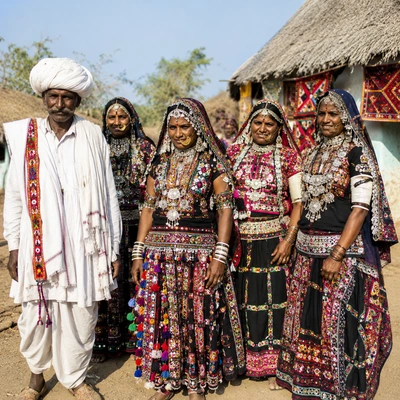
En route visit Banni Village, famous for Banni embroidery.

Mirror Embroidery: Also found in the Banni region. There are around 20 villages renowned for different types of handicrafts, including mirror work.

Mukka, Halopotra, Rasipotra, and Node are other communities in the Banni region that practice embroidery.

Mutva Embroidery: It derives its name from the Mutva (Maldhar), a sub-caste of Muslims living in Banni. They excel in all embroidery styles found in the Banni area of Kutch.

Patricate Prints: Another style of printing practiced in the district, particularly in Dhamadka.

Rogan Painting: The village of Nirona is home to the only place in the world where the tradition of Rogan Art is still practised (a method of producing dyes from natural resources and castor oil to create long-lasting designs on silk and cotton fabrics).

Evening dedicated to the Rann Utsav Festival.

What began as a three-day festival has gradually evolved into a 100-day celebration in Dhordo, a village near the Rann of Kutch, where an entirely new tent city is created, filled with temporary infrastructure that is built and rebuilt every year.

Overnight stay in Dhordo.

Day 5

December 24, 2026, - Dhordo – Mandvi (140 Km, 2 Hours 40 Minutes)

After breakfast, depart for Mandvi.

Meeting with the Dhow Builders of Mandvi: Dhows are built entirely from wood, using sal wood imported from Malaysia, Indonesia, and Myanmar or sourced locally from Gujarat’s babool trees. Handcrafted by artisans with little formal education and no engineering training, these vessels are created with remarkable skill without even referring to a sketch.

72 Jinalaya (72 Jain Temples):Mandvi is also famous for the 72 Jinalaya (72 Jain Temples), located 11 km from Mandvi near the village of Koday. This complex is an important Jain pilgrimage site and houses 72 Deris dedicated to Lord Mahavir.

Mandvi Beach and Wind Farm: Over time, Mandvi became an important trading centre. To accommodate the Kharva families, known for their expertise in wooden shipbuilding, the settlement was constructed within fortified walls. The mid-15th century witnessed the construction of defensive fortifications.

Overnight stay in Mandvi.

Day 6

December 25, 2026, - Mandvi – Anjar Market – Rajkot (325 Km, 6 Hours 30 Minutes)

After breakfast, depart for Rajkot.

Visit Anjar Market, Royal Garages, NaulakhaDarbargadh Palace.

Anjar Market: It is impossible to come to Anjar and return home empty-handed, as the city’s markets offer an exciting range of metal handicrafts.

Royal Garages (Closed on Sunday): Royal Garages houses an extensive collection of vintage and classic cars from 1910 to 1955, limousines and sports cars from the 1950s and 1960s, American cars from the 1940s and 1950s, and a fleet of four-wheel-drive vehicles from World War II and the post-war period.

Jubilee Garden: Jubilee Garden is an important part of Rajkot’s rich history. It is interesting to note that the garden was established after the founding of the Watson Museum in 1888.

Overnight stay in Rajkot.

Day 7

December 26, 2026, - Rajkot – Junagadh (112 Km, 2 Hours 50 Minutes)

After breakfast, depart for Junagadh.

Uparkot Fort: It is believed to have been built in 319 BC; the fort was an architectural work of Chandragupta. Throughout history, the fort passed under the control of various rulers, and even today remains from different periods and dynasties can still be seen.

Uparkot Caves: The Uparkot Caves, also known as Uperkot Caves, are ancient man-made caves. They form part of the Buddhist cave complex of Junagadh, located in the eastern part of the city in the Indian state of Gujarat.

MahabatMaqbara: Completed in 1892 and 1896 respectively, these monuments are dedicated to Mahabat Khan II, Nawab of Junagadh State, and his minister Bahauddin Hussain Bhar.

Adi-kadiVav: Built in the 15th century, Adi-kadiVav is entirely carved out of hard rock. A narrow staircase of 120 steps descends through the stone to reach the deep well below.

KhapraKodiya Caves: These caves are also known as Khangar Mahal. They were carved into the rock during the reign of Emperor Ashoka and are considered the earliest monastic settlement in the region.

Overnight stay in Junagadh.

Day 8

December 27, 2026, - Junagadh – Palitana – Bhavnagar (229 Km, 5 Hours 15 Minutes)

After breakfast, depart for Bhavnagar.

En route, visit the city of Palitana.

Palitana:Palitana is located 60 km from Bhavnagar. The hills of Palitana are known as the “Abode of the Gods” and are home to 863 Jain temples built over a period of more than 900 years.

Upon arrival in Bhavnagar, visit:

Barton Museum: Barton Museum is located on the ground floor of Gandhi Smriti, where visitors can admire a wide range of artefacts such as religious sculptures and nutcrackers that represent the culture of Saurashtra.

Overnight stay in Bhavnagar.

Day 9

December 28, 2026, - Bhavnagar – Lothal – Vadodara (224 Km, 4 Hours 40 Minutes)

After breakfast, depart for Vadodara.

En route, visit the historic city of Lothal.

Visit Lothal (closed on Fridays and public holidays). The city was inhabited in 3700 BC and was a thriving trading port. Excavations began on 13 February 1955 and continued until 19 May 1960 by the Archaeological Survey of India (ASI) to uncover the ancient city. The site has been nominated for inclusion on the UNESCO World Heritage List.

Upon arrival, visitLaxmi Vilas Palace: Laxmi Vilas Palace is one of the most majestic structures in India and was the private residence of Maharaja Sayajirao Gaekwad III. Known as one of the largest private residences in the world, with dimensions four times the size of Buckingham Palace, this magnificent palace is an absolute must-see when visiting Vadodara.

Overnight stay in Vadodara.

Day 10

December 29, 2026, - Vadodara – Kevadia (86 Km, 2 Hours)

After breakfast, depart for Kevadia.

Proceed to the Statue of Unity and transfer to the hotel.

Statue of Unity (closed on Monday): Located near the sacred Narmada River, the Statue of Unity is an iconic representation of national unity and is the tallest statue in the world. Dedicated to the Iron Man of India, Sardar Vallabhbhai Patel, who is credited with the unification of India, a visit to this statue inspires a deep sense of patriotism and admiration.

Narmada River Aarti: Held in Kevadia near the Statue of Unity, this is a captivating evening ceremony featuring devotional chants, traditional lamps, panoramic river views, and a deeply spiritual atmosphere.

Overnight stay in Kevadia.

Day 11

December 30, 2026, - Kevadia – Champaner – Ahmedabad (239 Km, 4 Hours 40 Minutes)

After breakfast, depart for Ahmedabad.

Champaner-Pavagadh Archaeological Park

En route, visit Champaner, an ancient fortified city. Visit one of the UNESCO World Heritage Sites. Champaner Fort is an ancient fort located at the foothills of Pavagadh. Mohammed Begada (the famous Muslim ruler of Gujarat) conquered the fort in the 15th century after a long siege against the Khichi Chauhan Rajputs. Highlights include Jama Masjid, Kevda Masjid, Saharwali Masjid, Saat Kaman, and others.

Nagina Masjid: Built during the reign of Mahmud Begada in the 15th century, along with several other mosques such as Kevada, Bawaman, EkMinar, Jama, Khajuri, and Shahar Ki. It features minarets, globe-shaped domes, and narrow staircases. It is part of the UNESCO World Heritage-listed Champaner-Pavagadh Archaeological Park.

Proceed to Gandhinagar and transfer to the hotel.

Overnight stay in Ahmedabad.

Day 12

December 31, 2026, - Ahmedabad – To Your Next Destination

Transfer to Ahmedabad Airport.

Ciao India Tours wishes you a pleasant journey.

Inclusions:

✔ 11 nights’ accommodation in 4-star/Heritage hotels with half board, including all applicable taxes.
✔  All transfers from the airport/railway station to the hotel and vice versa as per the itinerary.
✔  Meet and assist services upon arrival and departure by our representative at the airport.
✔  All transportation as per the itinerary by a large air-conditioned vehicle.
✔  Breakfast and dinner at the hotels.
✔ Tour guide throughout the trip.
✔  Monument entrance fees as per the itinerary.
✔  Tickets for activities as per the itinerary.
✔  One bottle of water per person per day.
✔  All applicable taxes included.
✔  Tolls, parking fees, fuel, and driver’s accommodation.

Exclusions:

✘ Visa, international flights, travel insurance, flight/train cancellation or modification charges, alcoholic beverages, lunch, tips, personal expenses, camera fees, etc.

✘ Any activity not specifically mentioned in the inclusions, such as Rickshaw Ride, Boat Ride, Elephant Ride, Camel Ride, Safari, etc.

✘ Tips for the driver, waiters, tour guides, etc.

✘ Tutto quello che non fa parte delle inclusioni.

✘ Anything not specifically mentioned under the inclusions.

To book this tour, please contact us via WhatsApp, inquiry form, chat, or email.

📱 WhatsApp: +91 99719 81381
📧 Email: info@ciaoindiatours.com

We remain at your complete disposal for any further information.

Receive free quote