Categories
Tour in ladakh

Heritage tour of Ladakh

Tour India withNepal

Heritage Tour of Ladakh

from 990 Euro/PP (min. 2 pax)

10 Nights/11 Days

Private Tour

Route

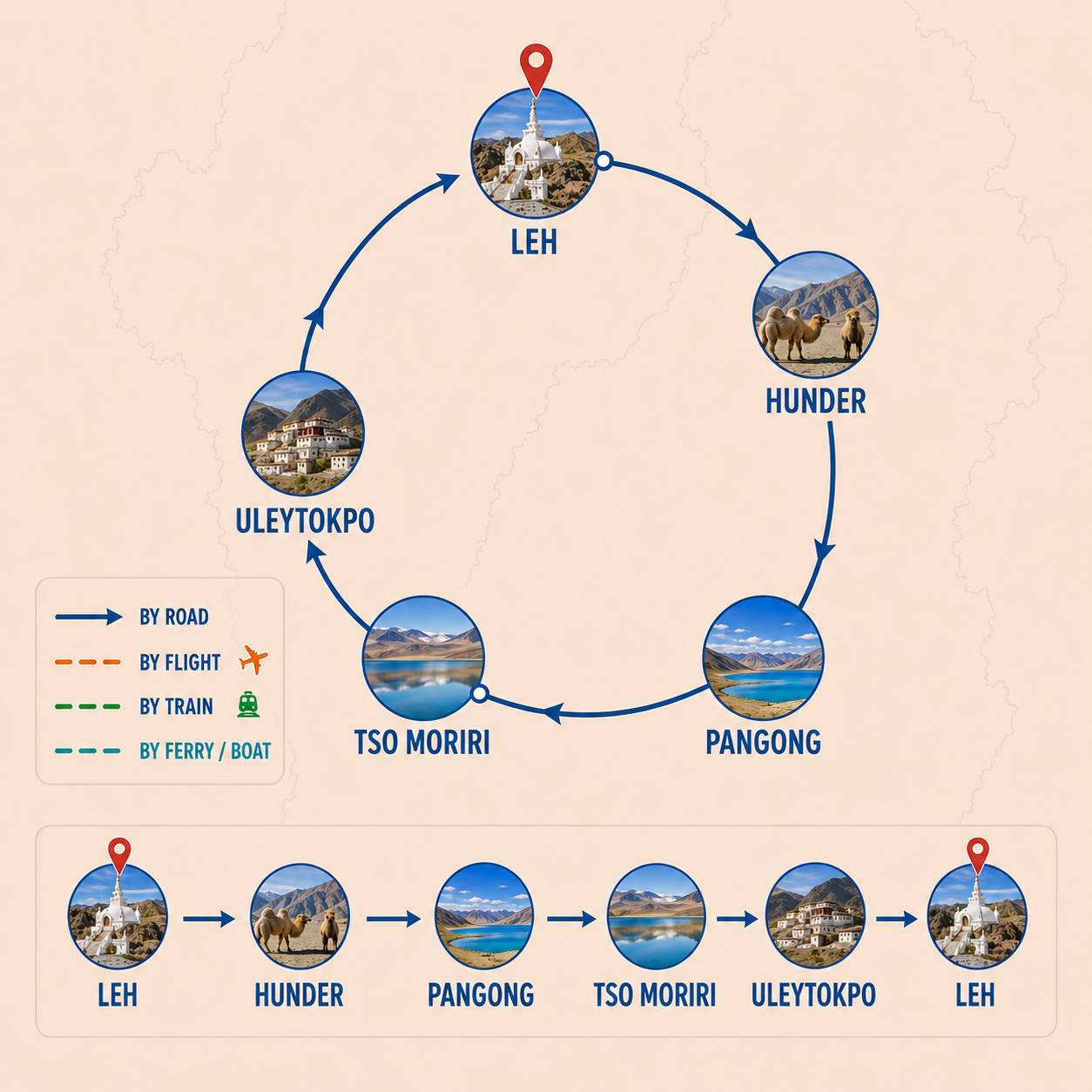
Leh → Hunder → Pangong → Tso Moriri → Uleytokpo → Leh

Day 1

Arrival in Leh

Upon arrival, transfer to the hotel.

Hotel standard Check-in 14:00 pm / Check-out 12:00 pm.

We recommend half a day of relaxation to acclimatise.

Leh Market: – The market is divided into several small paths and streets, with sections dedicated to clothes, artefacts, spices, food, souvenirs, and handicrafts. One of the best things that Leh Main Market is famous for is its woollen garments. Due to the cold climate, the people of Leh have a culture of making hand-woven woollen clothes, which have now become popular local products from Ladakh.

Overnight in Leh.

Day 2

Leh

After the breakfast.

Visit Shanti Stupa: – Shanti Stupa is also known as Vishwa Shanti Stupa. It is an important pilgrimage site for Buddhists. The impressive stupa is made of marble and there are brilliantly intricate statues of Lord Buddha here.

Leh Palace: – The roof of Leh Palace offers beautiful views of the Ladakh region and Stok Kangri. With huge wooden walls and balconies, it is a fine example of medieval Tibetan architecture and boasts nine floors. The entrance to the palace is decorated with carved wooden figurines.

Chemrey Monastery: – Chemrey Gompa in the Indus River Valley is a Buddhist monastery built in 1664 in the Leh district of Ladakh in northern India. It is located 6 kilometres (3.7 miles) north of Hemis Monastery.

Stakna Monastery: – Known as Tiger Nose due to its resemblance to it, Stakna is a small monastery in Leh founded by the Bhutanese scholar and saint Chosje Jamyang Palkar in 1580. The monastery is located on the left bank of the Indus River and offers splendid views over the valley.

Matho Monastery: – The history of Matho Monastery states that it was founded in the 15th century by Lama Dugpa Dorje. The gompa belongs to the Sakya Order and houses thangkas dating back 400-600 years.

Free time to explore the city on your own.

Overnight in Leh.

Day 3

Leh-Khardung La-Diskit-Hunder (125 Km, 3 Hours and 35 Minutes)

After breakfast, departure for Hunder.

En route, we visit Khardung La Pass.

Khardung La Pass: – Khardung La Pass is a gateway to some of the most enchanting and unexplored landscapes. This famous mountain pass is very popular among adventurers and regular tourists alike. Located in the Leh district of the Indian Union Territory, Khardung La is situated at an altitude of 5,359 metres.

Diskit: – Dating back to the 14th century, this monastery is considered the largest and oldest monastery in the Nubra Valley. Also known as Diskit Gompa, the most prominent attraction of the monastery is the huge Maitreya Buddha statue at the top, which was inaugurated by His Holiness the Dalai Lama.

Maitreya Buddha: – The 32-metre-high statue of Maitreya Buddha faces the Shyok River. This statue was built recently with 8 kg of gold donated by the head of the Gompa and was sanctified by the Dalai Lama on 24 July 2010.

Upon arrival in Hunder, transfer to the hotel.

Overnight stay in Hunder.

Day 4

under-Samstanling-Panamik-Ensa-Nubra Valley-Hunder (Return 173 Km, 4 Hours and 40 Minutes)

After breakfast, the day begins.

Samstanling: – Located in Sumlur village in the Nubra Valley region, Samstanling Monastery was founded 140 years ago in 1841 by Lama Tsultim Nima. The monastery is located 124 km from Leh and serves more than 50 monks with their daily needs.

Panamik: – Panamik Hot Water Spring is located at an altitude of 10,442 feet above sea level. The spring water contains a high amount of sulphur and is considered beneficial for treating rheumatism and other ailments.

Ensa: – Ensa Monastery, otherwise known as Ensa Gompa, is located in the vicinity of Panamik village. Travellers must visit this 250-year-old monastery as it is considered one of the major attractions of Nubra Valley.

Nubra Valley: – Surrounded by snow-capped Himalayan ranges, Nubra Valley is located between Tibet and Kashmir. The view of the valley is picturesque and breathtaking. During winter, the whole valley looks like a lunar landscape (which is why it is called Moonland), while in summer it is full of greenery.

Return to Hunder, transfer to the hotel.

Overnight stay in Hunder.

Day 5

Hunder-Shyok-Pangong (277 Km, 6 Hours and 50 Minutes)

After breakfast, departure for Pangong.

Along the way, we visit Shyok (Altitude 3700 m).

Start the day by following the same route towards Leh until reaching Khalsar. From Agyam Bridge, we will take the left road that leads to the villages of Shyok and Durbuk. The route is less frequently used for commuting, so you will not find heavy traffic on most days.

Upon arrival, transfer to the hotel.

Overnight in Pangong.

Day 6

Pangong-Tsomoriri (180 Km, 7 Hours) (Half Board with Dinner)

After breakfast, departure for Tsomoriri.

Morning at leisure to explore the beauty of the lake and then continue east. This is a new route recently opened to tourists. Drive along Pangong Lake, passing through the villages of Man, Mirak, and Chushul (which is only 80 km from the Chinese border and is famous for the memorial of Major Shaitan Singh, who sacrificed his life in the Sino-Indian War of 1962, and where the Chinese and Indian Army flag meeting is held every year). We also drive to Tsaga and Loma Curve, and once you reach Mahe, turn left and continue driving until you reach Tsomoriri.

Overnight stay in Tsomoriri.

Day 7

somoriri-Leh (240 Km, 7 Hours) (Half Board with Dinner)

After breakfast, depart for Leh.

Puga: – Puga Valley is located in the Changthang Valley in the south-eastern part of Ladakh, about 22 km from the Salt Lake Valley. It is a region of great importance known for its natural beauty and geothermal activities. Puga is also visited for its hot sulphur springs.

Tsokar Lake: – Tso Kar or Tsokar is a salt lake known for its size and depth, located in the Rupshu Plateau and valley in the southern part of Ladakh, India. It is also recognised as India’s 42nd Ramsar site.

Along the way, stop at Tanglang La Pass, the second highest motorable pass in the world at 5,350 m.

Overnight stay in Leh.

Day 8

Leh-Hemis-Thiksey-Shey-Stok-Leh

After breakfast

Visit Hemis: – Among the richest monasteries in India, Hemis Monastery is renowned for its collection of ancient artefacts, including a copper Buddha figure, gold and silver stupas, and more. Sacred thangkas, murals, and other objects can be seen throughout the monastery.

Thiksey: – Thiksey Monastery belongs to the Gelug or Yellow Hat sect of Tibetan Buddhism. It is also known for its annual Gustor festival held in the month of October/November, where a fair is organised at the base of the monastery and villagers from all over Ladakh come to barter, exchange items, and socialise.

Shey: – It is home to the second largest Buddha statue in Ladakh. Shey Monastery is located within the Shey Palace complex. The original palace, now in ruins, was built near the village of Shey by Lhachen Palgyigon, king of Ladakh (then called Maryul), in the 10th century.

Stok: – Situated on the banks of the Indus River on the outskirts of the city, the Stok Palace is a magnificent three-storeyed structure. Still the summer residence of the Ladakh royal family, around 12 of its 80 rooms are still functional.

Arrival in Leh, transfer to the hotel.

Overnight stay in Leh.
Day 9

Leh-Basgo-Alchi-Likir-Uleytokpo (125 Km, 2 Hours and 45 Minutes)

After breakfast, departure to Uleytokpo.

En route visit Basgo: – Although the monastery was built for the Namgyal rulers in 1680, Basgo itself was incorporated in the early days of Ladakh and is often mentioned in the Chronicles of Ladakh when it was a political and cultural centre.

Gurudwara Patthar Sahib: – Situated on the outskirts of Leh on the Leh-Kargil road, Gurudwara Pathar Sahib was built in memory and honour of Guru Nanak. This place of worship is associated with a very important event in the history of the Sikh religion.

Magnetic Hill: – Magnetic Hill is a gravity hill located near Leh in Ladakh, India. The layout of the area and the surrounding slopes create the optical illusion of a hill. The hilly road is actually a downhill road. Objects and cars on the road may appear to roll uphill, defying gravity, when in reality they are rolling downhill.

Likir: – Likir Monastery was first built in the 11th century and rebuilt in the 18th century. It currently houses a 25-foot (7.6 m) tall gold-covered Buddha statue. It is occupied by monks of the Gelukpa order and is located 52 km from Leh.

Upon arrival in Uleytokpo, transfer to the hotel.

Overnight stay in Uleytokpo.

Day 10

Uleytokpo-Kargil (91 Km, 3 Hours and 10 Minutes)

After breakfast, departure for Leh.

Along the way, visit:

Shargole Cave Monastery – The Shargole Cave Monastery is located about 31 km from Kargil and is a remarkable example of architecture. As you approach the village, you can see from a distance a white structure embedded in a yellow-brown hillside.

Alchi Monastery – According to the history of Alchi Monastery, it was founded in the 10th century by the renowned scholar and translator Rinchen Zangpo.

Overnight stay in Leh.

Inclusions:

✔ 11 nights’ accommodation in 3/4 star/Heritage hotels with breakfast, including all existing taxes.
✔ All transfers from the airport to the hotel and vice versa.
✔ Meeting and assistance upon arrival/departure from our representative at the airport.
✔ Transfers as per the program with a private car.
✔ One bottle of water per person every day.
✔ All taxes included.

Exclusions:

✘ Visa, health insurance, cancellation of flights, trains, tips, tourist guide, monument tickets, activities, personal expenses, camera fees, etc.

✘ Everything that is not part of the inclusions.

To book this tour, please contact us via WhatsApp, inquiry form, chat, or email.

📱 WhatsApp: +91 99719 81381
📧 Email: info@ciaoindiatours.com

We remain at your complete disposal for any further information.

Receive free quote