Categories
Uncategorized

Tour in Oman with India

Tour in Oman with India

Private Tours

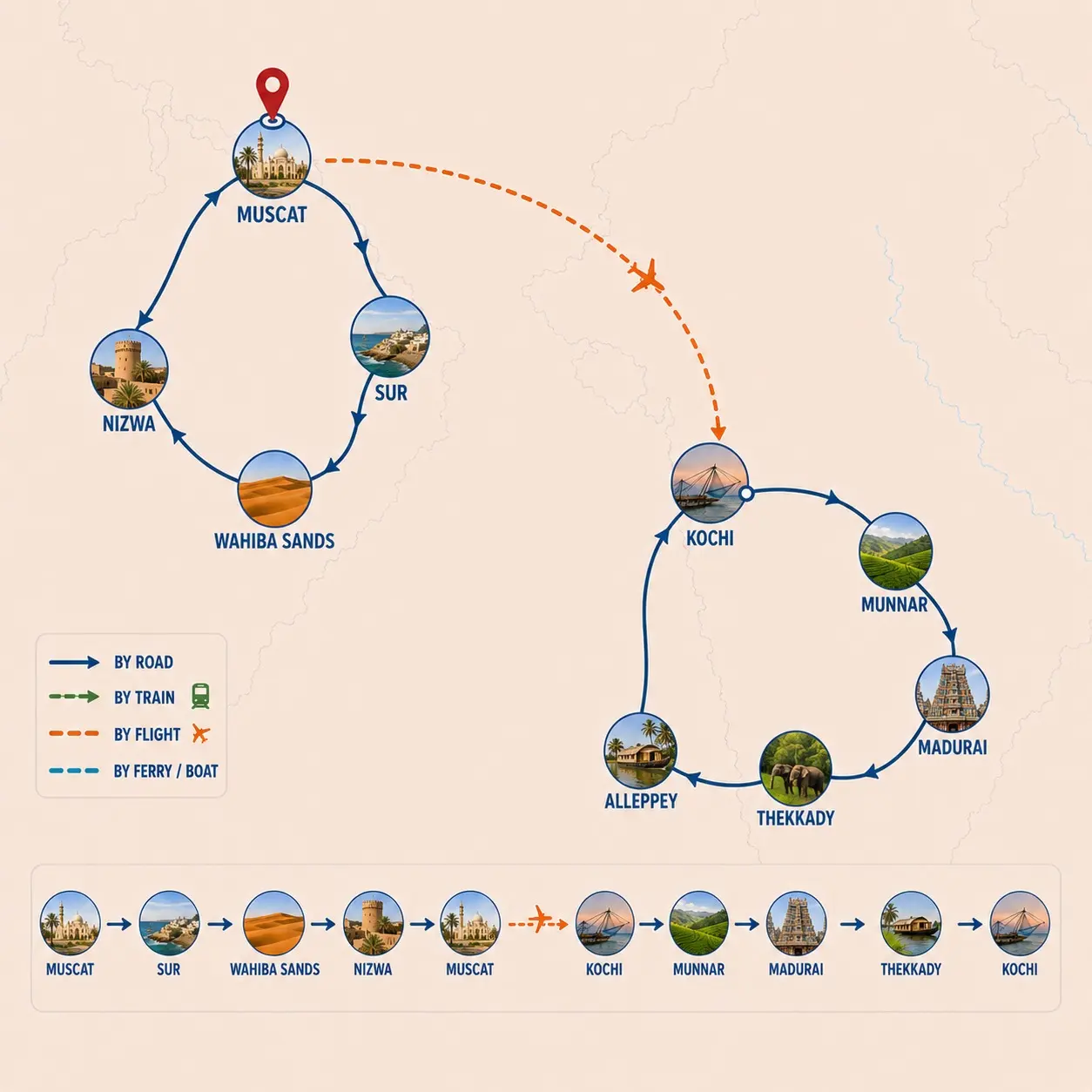
Route

Muscat → Sur → Wahiba Sands → Nizwa → Muscat → Kochi → Munnar → Madurai → Thekkady → Alleppey → Kochi

Day 1

Arrival in Muscat

Arrival at Muscat International Airport.

After completing immigration formalities and collecting your luggage, our representative will be waiting outside the terminal to assist you with the transfer to Muscat.

Arrival at the hotel and check-in. Standard check-in time: 15:00 hrs / Standard check-out time: 12:00 hrs.

The Grand Mosque: The mosque is a masterpiece of contemporary architecture and a beautifully crafted place of worship, featuring a harmonious blend of Islamic, Omani, and Middle Eastern architectural styles.

Note – Visiting Hours & Dress Code:
For non-Muslims, the mosque is open from Saturday to Thursday between 08:00 hrs and 11:00 hrs. Muslims may visit at any time. Women should cover their heads with a scarf and wear long-sleeved shirts/tops/T-shirts, with legs covered down to the ankles. Men should wear full-length trousers and a shirt or short-sleeved T-shirt. Transparent clothing and outfits featuring images of living beings are not permitted for either men or women.

Muttrah Souq: Muttrah Souq is famous for its traditional handicrafts such as Omani pottery, silver jewelry, spices, frankincense, traditional Omani clothing for both men and women, traditional khanjars (daggers), perfumes, dates and honey, meat, fruits and vegetables, and the traditional Omani sweet, halwa.

Muttrah Fort: The fort is believed to have originally been built in 1507 AD and was later modified and strengthened with stronger towers and walls by the Portuguese during their occupation of Oman in the 1500s.

Bait Al Zubair Museum: Located in the city of Muscat, this private museum houses historical objects related to Oman’s cultural, military, and social heritage.

Al Alam Palace (Photo Stop): This royal palace carries over 200 years of history and allows visitors to take photographs from the outside. Also known as the Sultan Qaboos Palace.

Mirani and Jalali Forts (Photo Stop): These 16th-century forts were built by the Portuguese to protect the harbor of Muscat. Visitors are not allowed inside, but they can enjoy impressive views from the outside.

Royal Opera House: The architecture of the Royal Opera House is a blend of Italian and Islamic styles, featuring refined use of Omani desert rose stone

Overnight stay in Muscat.

Day 2

Muscat – Bimmah Sinkhole – Wadi Shab – Sur (246 Km, 4 Hours)

After breakfast, the day begins.

Along the way, you visit:

Bimmah Sinkhole (Swimming Possible): A stunning natural depression filled with turquoise water, located between Muscat and Sur.

Wadi Shab (Trekking Possible – Approx. 1 hour 30 minutes round trip | Moderate Difficulty): Wadi Shab is one of the most picturesque locations in the country. Views from the surrounding cliffs provide a breathtaking perspective of its turquoise waters and rugged landscape.

Upon arrival in Sur, visit the Dhow Factory: Explore the courtyard where traditional dhows are continuously constructed using the same techniques that have been followed for centuries

Al Ayjah Lighthouse: Visit the three-story lighthouse majestically perched along the Sur coast. Historically, it served as a watchtower to protect the community from raiders and was later converted into a lighthouse to guide dhows into the Sur lagoon.

Overnight stay in Sur.

Day 3

Sur – Wadi Bani Khalid – Wahiba Sands (Desert) (173 Km, 3 Hours and 40 Minutes)

After breakfast, depart for the desert.

En route visit:

Wadi Bani Khalid (Swimming Optional): While the southern part, known as Wadi Hayer, features mountainous terrain ideal for trekking, the northern section is a recreational area with crystal-clear natural pools, palm trees, and rocky cliffs, perfect for swimming and picnics.

Note: Wadi Bani Khalid is a spectacular oasis set among the Omani mountains, famous for its natural pools and scenic rock formations. Foreign visitors may swim while respecting local rules: modest swimwear is required (men should wear shorts; women should wear a T-shirt and leggings), the use of soap or shampoo is not permitted, changing rooms should be used, loud noise should be avoided, and nature and safety regulations must be respected.

Desert Experience – Wahiba Sands: Upon arrival in the desert, visit a Bedouin house and explore the vast dunes of the region, popularly known as the Wahiba Sands. First-time visitors are often truly amazed by the beauty of the ever-changing dunes and their shifting colors.

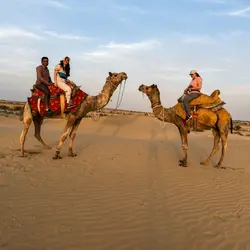
Camel Ride in Wahiba Desert (Optional – at an additional cost of 5 OMR per person): Enjoy an authentic camel ride across the majestic golden dunes, offering a unique adventure to immerse yourself in Bedouin culture and the spectacular landscapes of Oman.

Dinner and overnight stay in the camp.

Day 4

Desert – Ibra – Nizwa (231 Km, 2 Hours and 50 Minutes)

After breakfast, depart for Nizwa.

En route, visit Ibra: Ibra is one of the oldest cities in Oman and was once a center of trade, religion, education, and art. The city gained importance as a major meeting point at the foothills of the Ash Sharqiya region. Ibra is home to the Al Harthy, Al Maskari, Al Mughairi, and Al Riyami tribes, some of the largest tribes in Oman, all of which are strongly represented in the city.

Jabreen Castle: Jabreen Castle rises majestically from the surrounding plain. Despite having strong defensive features, it is considered one of the most beautiful and well-preserved castles in Oman, making it well worth exploring its various levels and towers.

Bahla Fort: One of the largest forts in Oman, Bahla Fort now dominates the modern town of Bahla after years of restoration. It was built by the Bani Nabhan tribe.

Upon arrival in Nizwa, transfer to the hotel.

Overnight stay in Nizwa.

Day 5

Nizwa – Muscat (160 Km, 1 Hour and 45 Minutes)

After breakfast, depart for Muscat.

Nizwa Souq (Market): Friday is a special day for those exploring Oman. Nizwa becomes particularly lively as “Al Habta,” the traditional goat market, takes place every Friday morning.

Nizwa Fort: The construction of Nizwa Fort began in the 17th century under Sultan bin Saif Al Yarubi, the most prominent member of the Yarubi tribe, and was completed over a period of twelve years.

Nizwa Tower: The foundation of the tower extends 30 meters (98 feet) underground. One of its most impressive features is the massive cylindrical, drum-shaped tower, approximately 45 meters (148 feet) in diameter and about 34 meters (112 feet) high.

En route, visit Birkat Al Mouz: In Oman’s Nizwa province, in the Ad Dakhiliyah district, lies the historic village of Birkat Al Mouz. It is also home to the reconstructed fort known as Bait Al Redidah and serves as the gateway to Wadi Al Muaydin on the southern edge of Jebel Akhdar.

Izki: The Wilayat of Izki was historically considered a meeting point for various trade caravans. With a population of around 35,000, it is located approximately 130 km south of Muscat.

Arrival in Muscat.

Overnight stay in Muscat.

Day 6

Muscat – Kochi (Flight)

After breakfast, depart for Kochi.

Transfer to Muscat Airport according to the flight schedule for Kochi.

Upon arrival, visit Mattancherry Area: It is inhabited by people of different linguistic and ethnic backgrounds. Churches, agraharams, mosques, and a synagogue coexist within the same area, along with colonial-era buildings, reflecting a vibrant past and a harmonious present.

Chinese Fishing Nets: The Chinese fishing nets, made of teak wood and bamboo poles, operate on the principle of balance. Each structure, approximately 10 meters high, is fixed on the beach.

Jew Street: Here, you can find curiosities, antique utensils, carved wooden furniture, bronze and brass sculptures, remnants of traditional houses, and jewelry.

The Synagogue (Closed on Fridays, Saturdays, and during all Jewish holidays): The Paradesi Synagogue, located in a corner of Jew Town, is more than one hundred years old and houses numerous rare antique objects.

Dutch Palace (Closed on Fridays): In 1555, the Portuguese built the palace and presented it to King Veera Kerala Varma to establish trade relations. Later, the Dutch renovated the building.

Santa Cruz Cathedral Basilica: Located in Fort Kochi, it is one of the nine basilicas in Kerala. Considered one of the most important historical buildings in the region.

Dhobi Khana: It is the place where the Tamil-speaking Vannan community carries out laundry activities, the traditional occupation of this community.

Overnight stay in Kochi.

Day 7

Kochi-Munnar (127 km, 3 hours and 40 minutes)

After breakfast, depart for Munnar.

Pothamedu Viewpoint:- Experience the magnificent panoramas of Munnar! Visit Pothamedu, a hilltop site from where you can enjoy stunning views of the surrounding mist-covered hills and lush green valleys caressed by cool breezes.

Pallivasal Waterfalls:- The Pallivasal Falls in Munnar are a secluded yet scenic tourist attraction. These waterfalls are formed by the Muthirappuzhayar River and are among the most popular in the region.

Blossom Park:- This park is located in one of the most beautiful areas of the region. It offers numerous activities, including boating, skating, and cycling. If you prefer a more peaceful visit, you can admire the trees and a wide variety of beautiful flowers.

Tea Factory:- The plantations have significantly contributed to attracting visitors to the area. Tata Tea established the Tea Museum in 2005, where photographs and machinery showcasing the history of tea production in the region are displayed.

Overnight stay in Munnar.

Day 8

Munnar

After breakfast, the day begins.

Trekking:- Munnar is one of the best destinations in Kerala for soft trekking through tea plantations, green hills, and breathtaking landscapes.

Echo Point:- Located about 15 km from Munnar, Echo Point is famous for its natural echo phenomenon. It remains a popular attraction visited by numerous tourists throughout the year.

Mattupetty:- Mattupetty is among the most visited destinations in the Munnar tourist region. It is a beautiful picnic spot that regularly attracts visitors.

Photo Point:- Although much of Munnar is highly photogenic, Photo Point stands out even more. Located just 3 km from the town’s main market, this site is especially popular among photographers.

Carmelagiri Elephant Park:- Carmelagiri Elephant Park offers an authentic and immersive experience with elephants in the heart of Kerala’s tropical nature. Visitors can observe these magnificent animals up close and discover the local traditions and culture of the region.

Kathakali Performance:- Kathakali is one of the major forms of Indian classical dance. It is a narrative theatrical art form characterized by elaborate makeup, colorful costumes, and vibrant masks traditionally worn by male actor-dancers.

Overnight stay in Munnar.

Day 9

Munnar-Madurai (160 km, 3 hours and 55 minutes)

After breakfast, depart for Madurai.

Flower Market:- In addition to the impressive temples of Madurai, the city’s flower market, located between the central market and the Maatuthavani bus station, is a vibrant representation of local life that travelers should not miss. This enormous market, one of the largest in India, exports various species of flowers, including the exclusive and fragrant Madurai Malli (jasmine).

Thirumalai Nayakar Palace:- Thirumalai Nayakar Palace was built in 1636 AD in the city of Madurai by King Thirumalai Nayak. It represents a perfect blend of Dravidian and Rajput architectural styles.

Banana Market:- Madurai’s banana market is a wholesale market located in Rukmanipalayam. Sixteen varieties of bananas are traded here, making it one of the most popular commercial centers in the city.

Pudhu Mandapam – Traditional Handicrafts:- A lively market situated in the heart of Madurai. This historic bazaar is famous for its traditional handicrafts, fine silk sarees, and intricately designed jewelry.

Meenakshi Temple:- Built in the 14th century, it features four imposing towers called gopurams, with the tallest reaching approximately 170 feet. More than 33,000 sculptures adorn the temple, and the roof is covered with intricate designs. Among its most remarkable features are the Hall of 1,000 Pillars and the famous musical pillars.

Overnight stay in Madurai.

Day 10

Madurai-Thekkady (141 km, 3 hours and 30 minutes)

After breakfast, depart for Thekkady.

Upon arrival, visit the Spice Plantation:- Spice plantations are a unique attraction in Thekkady, Kerala, and most visitors do not miss this interesting experience.

Boat Ride at Periyar National Park & Wildlife Sanctuary:- The park is widely known for Lake Periyar. Managed by the Kerala Forest and Wildlife Department, the lake attracts hundreds of thousands of visitors every year.

Kalaripayattu Performance:- Considered one of the oldest and most scientific martial arts in the world, Kalaripayattu was developed in Kerala. Praised as the pride of Kerala, the training begins with a full-body oil massage to make the body agile and flexible. Techniques such as chattom (jumping), ottam (running), and marichil (somersaulting) are also integral parts of this art form.

Later, return to the hotel and relax.

Overnight stay in Thekkady.

Day 11

Thekkady-Alleppey (141 km, 3 hours and 30 minutes) (Full Board)

After breakfast, depart for Alleppey.

Arrival in Alleppey and transfer to the hotel; the rest of the day is dedicated to the boat ride.

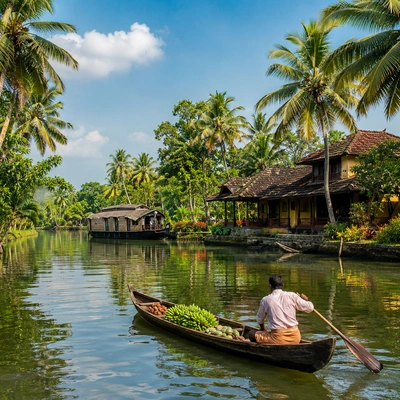
Alleppey:- Popularly known as the “Venice of the East,” Alleppey (Alappuzha) is famous for its tranquil backwaters and exceptionally scenic landscapes. A houseboat cruise is undoubtedly one of the best ways to admire the extraordinary natural beauty of this picturesque destination and is considered one of the most fascinating experiences to enjoy in Alleppey.

In the late afternoon, enjoy a Boat Excursion:- Disembark from the houseboat and board a smaller boat to observe the daily life of the local inhabitants. These shores seem untouched by time, surrounded by vast paddy fields and coconut palms gently swaying in the breeze.

Dinner and overnight stay in Alleppey.

Day 12

Alleppey-Kumarakom-Kochi (81 km, 2 hours and 20 minutes)

After breakfast, depart for Kochi.

En route, visit Aymanam:- Hidden on the outskirts of the city of Kottayam, the small village of Aymanam has a special story to tell. Famous for its extraordinary natural beauty and rich cultural diversity, it represents one of the lesser-explored treasures of “God’s Own Country.”

Kumarakom Bird Sanctuary:- It is one of the most famous birdwatching destinations in the country. Spread across approximately 14 hectares, it is home to numerous rare species of birds.

Upon arrival in Kochi, transfer to the hotel.

Overnight stay in Kochi.

Day 13

Kochi-To you next destination

Transfer to Kochi Airport.

Ciao India Tours wishes you a pleasant journey.

Inclusions:

✔ 12 nights’ accommodation in 3-star/heritage hotels, including breakfast and all applicable taxes.

✔ All transfers from the airport/station to the hotel and vice versa, as per the itinerary.

✔ All transfers and excursions as per the itinerary by air-conditioned vehicle.

✔Half board in the desert in Oman.

✔ Flight from Muscat to Kochi.

✔ Shikara ride (traditional boat) in Alleppey.

✔ One bottle of water per person per day.

✔ All taxes included.

✔ Toll charges, parking fees, fuel, and driver’s accommodation.

Exclusions:

✘ Visa fees, international flights, travel insurance, cancellation/modification charges for flights and trains, alcoholic beverages, lunch and dinner, tour guide services, entrance fees to monuments and activities, tips, personal expenses, camera fees, etc.

✘ Tips for the driver, waiters, tour guides, etc.

✘ Anything not specifically mentioned under the inclusions.

To book this tour, please contact us via WhatsApp, inquiry form, chat, or email.

📱 WhatsApp: +91 99719 81381
📧 Email: info@ciaoindiatours.com

We remain at your complete disposal for any further information.

Visit Our Office in India

Receive free quote